PONY Mustang 10U — public training pack

Content revision 395b38e1e61ea01acab1 · compiled October 14, 2026.

Public reference only. No account, answers you saved, notes, private plans or review results are stored here. References may require a connection. Follow the current official rules and complete drill setup; this pack does not establish readiness or permission.

Lesson reference

Hitting Mechanics & Plate Approach

Situation 01

Build a repeatable ready position

Before a tee rep, settle into an athletic stance. Keep your eyes level and leave room for your hands to move. This is a coaching starting point, not a required stance.

Which adjustment helps you compare your next two swings?

Coach answer: Use a balanced setup and change one cue at a time A steady setup makes the next swing comparable. Change one cue, then notice whether balance and contact improve.

Coaching Points

Watch balance at contact before adding a second instruction.

Common Mistakes

A long list of cues can make a player freeze.

Alternative Considerations

A comfortable stance can differ by player; use contact quality rather than appearance.

Coaching tip

Situation 02

Choose a pitch to attack

The coach asks you to name the pitch location you can drive before entering the box. Pick a simple target zone, then adjust with the count.

What is a useful first-pitch plan?

Coach answer: Look for a pitch in your planned zone and be ready A target zone gives you a reason to swing or take. You can adjust the plan when the count or coach's sign changes.

Coaching Points

Ask the player to describe the decision, not just the result.

Common Mistakes

A hit on a chased pitch does not make chasing a repeatable plan.

Alternative Considerations

Team instructions may change with the count and situation; agree before the at-bat.

Coaching tip

Situation 03

Compete with two strikes

During a coach-led drill, you have two strikes. The coach mixes pitches in and outside the strike zone.

Which approach helps you practice deciding whether to swing?

Coach answer: Explain each swing or take using the pitch's location and the two-strike count. Explain where the pitch was and why you swung or took it. Practice protecting reachable strikes without chasing pitches outside the zone. Making contact alone does not tell you whether the decision fit the pitch.

Coaching Points

Use mixed locations and let the hitter explain the read.

Common Mistakes

Calling every swing good because contact occurred hides poor decisions.

Alternative Considerations

A smaller stride is an option, not a universal requirement.

Coaching tip

Situation 04

Keep a bunt drill controlled

In a coached bunt station, rehearse foot placement without a live throw first. Keep fingers out of the ball's path and stop the rep if positioning is unsafe.

What should happen before speeding up this station?

Coach answer: Show a controlled setup and clear safety spacing Start slowly with safe spacing and fingers clear of the ball. Add speed only after the setup stays controlled.

Coaching Points

Use a coach-controlled progression and stop an unsafe rep.

Common Mistakes

Speed can hide a grip or spacing problem.

Alternative Considerations

Use a soft practice ball and dry repetitions when the group is learning.

Coaching tip

Situation 05

Stay balanced through contact

A controlled pitch enters the hitter's chosen zone and the front foot has landed.

What helps the hitter make controlled contact?

Coach answer: Keep the head steady and turn the barrel through the ball Keeping the eyes on the ball and turning the barrel through the hitting zone supports controlled contact without lunging.

Coaching Points

Use a tee or controlled toss to compare balanced contact with a reach.

Common Mistakes

Reaching early or looking away makes the barrel harder to control.

Alternative Considerations

Players can have different comfortable contact points; watch the ball and stay balanced.

Coaching tip

Situation 06

Prepare safely on deck

A supervised on-deck player waits in the designated area wearing the protective headgear PONY requires.

What preparation fits this PONY setting?

Coach answer: Use the designated area with headgear and safe spacing Use the designated on-deck area with headgear and enough space from teammates.

Coaching Points

Confirm the area is clear and controlled before a warm-up swing. The adult owns the safety check.

Common Mistakes

Being next to bat does not make an occupied area safe to swing in.

Alternative Considerations

The coach can use a no-swing waiting routine as a coaching choice without calling it a national ban.

Related rule or safety source: Equipment

Learn first

Learn the skill

Read these ideas, then try the situations below. Practice with a coach when a movement is new.

Quiz Mode: try each answer before checking the explanation.

Coach View: use the answers and teaching notes to guide practice.

Hold the bat for control

Place your hands together on the handle with a comfortable grip. Keep the barrel ready without squeezing so hard that your arms lock. If the bat feels too heavy to control, ask a coach to check the size.

Build the swing from the ground

Start in a balanced stance with your eyes on the pitcher and your hands free to move. As the pitch arrives, stride under control, turn your hips and torso, then bring the barrel through the hitting zone. A swing that stays balanced lets you adjust to a different pitch.

See example: Slow swing rehearsal
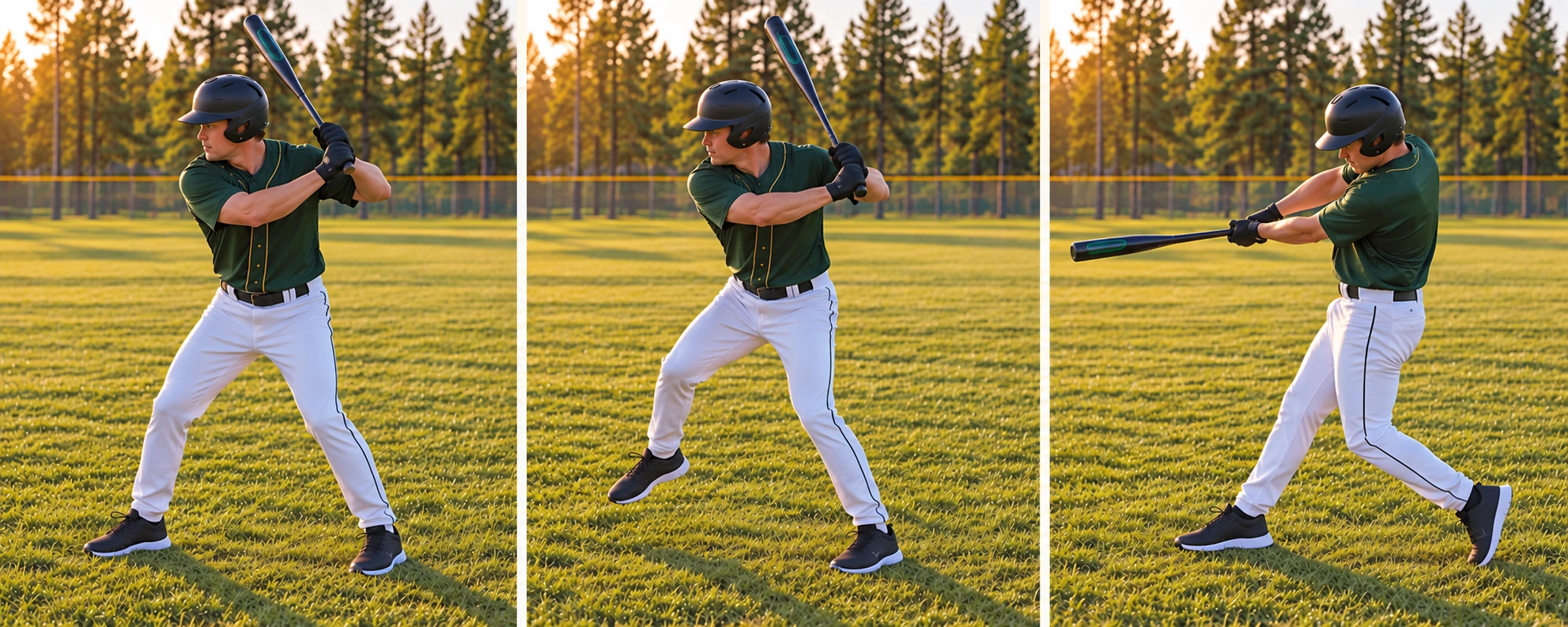
The same right-handed adult instructor demonstrates a balanced stance, a small front-foot movement and rotated swing extension in three frames, without a ball.
Adult demonstration of a slow dry rehearsal, left to right: balanced start → small front-foot movement → turn and extend toward an imagined contact area. There is no ball and no actual contact shown. This is an example, not an exact stride or grip prescription. Left-handed hitters reverse sides; practice with a coach. Generated illustration.

Load, stride and find contact

Make a small, repeatable load as the pitcher prepares, then stride toward the pitch without lunging. Track the ball as long as you can. Meet it out front when the pitch allows, keep the barrel through the hitting zone and finish balanced. On a tee, make three controlled swings to one target before changing one part of your setup.

Plan the at-bat

Before stepping in, choose a pitch location you can drive. Swing when the pitch matches the plan; take a pitch outside it when the count allows. With two strikes, protect the reachable strike zone with a controlled swing rather than guessing at every pitch.

Practice a bunt safely

First rehearse the position without a thrown ball. Put the bat in front of you under control and keep your fingers away from the ball's path. Ask the coach to stop the station if spacing or grip is unsafe.

Practice it here

On a 60-foot field, use a tee or soft front toss to keep the head steady through contact. Have the coach inspect the game bat before a full-speed station.

Which adjustment helps you compare your next two swings? — explanation

Use a balanced setup and change one cue at a time. A steady setup makes the next swing comparable. Change one cue, then notice whether balance and contact improve.

What is a useful first-pitch plan? — explanation

Look for a pitch in your planned zone and be ready. A target zone gives you a reason to swing or take. You can adjust the plan when the count or coach's sign changes.

Which approach helps you practice deciding whether to swing? — explanation

Explain each swing or take using the pitch's location and the two-strike count.. Explain where the pitch was and why you swung or took it. Practice protecting reachable strikes without chasing pitches outside the zone. Making contact alone does not tell you whether the decision fit the pitch.

What should happen before speeding up this station? — explanation

Show a controlled setup and clear safety spacing. Start slowly with safe spacing and fingers clear of the ball. Add speed only after the setup stays controlled.

What helps the hitter make controlled contact? — explanation

Keep the head steady and turn the barrel through the ball. Keeping the eyes on the ball and turning the barrel through the hitting zone supports controlled contact without lunging.

What preparation fits this PONY setting? — explanation

Use the designated area with headgear and safe spacing. Use the designated on-deck area with headgear and enough space from teammates.
Public full lesson (connection required)

Situational Defense Reference

Situation 01

Know your next play

Before each pitch, the shortstop checks the outs, runners and likely force play, then shares the coverage call with the second baseman.

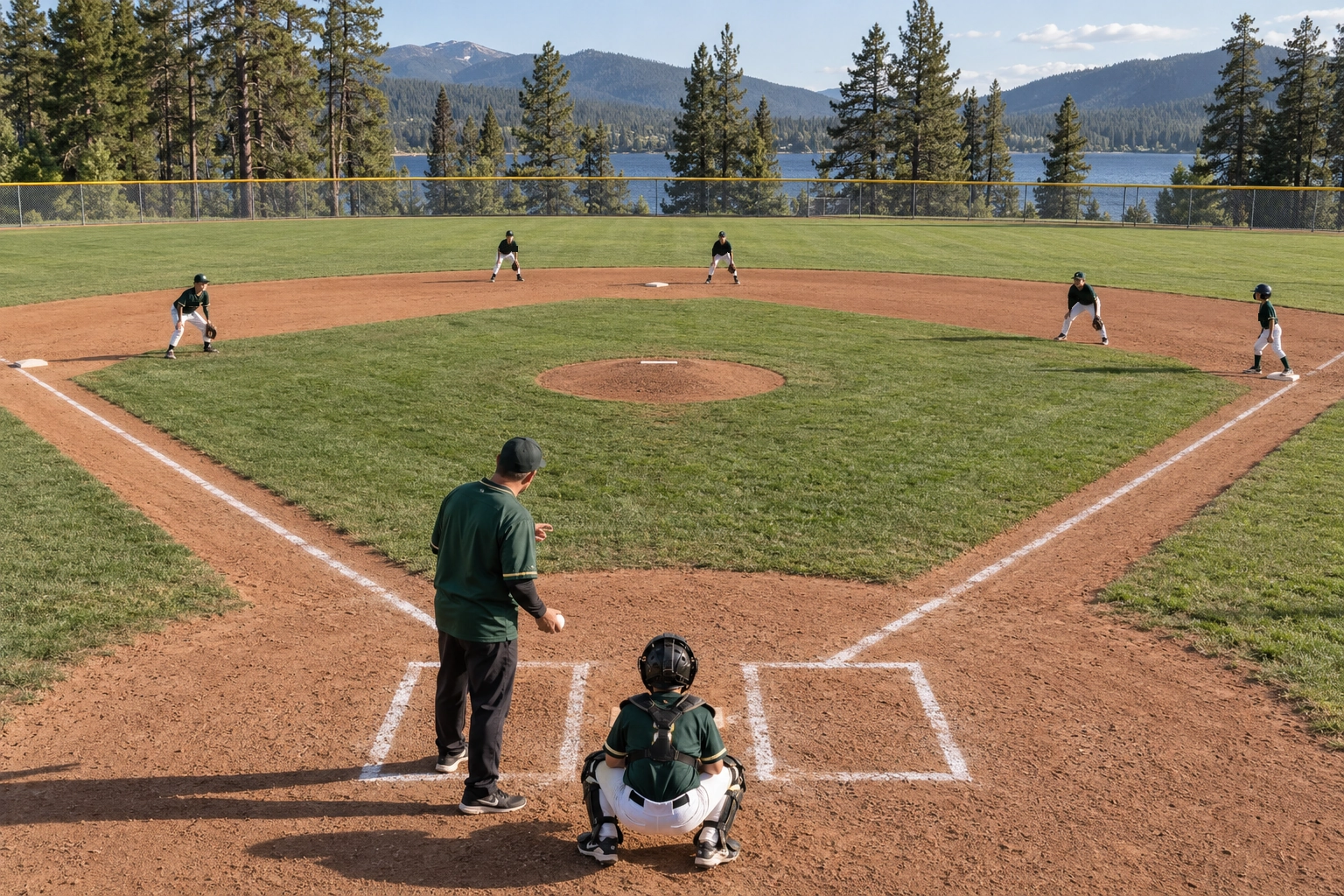
Where everyone plays: PONY Mustang 10USchematic baseball field, not to scale, home plate at the bottom. Bases are 60 feet apart and the pitching distance is 46 feet. Circles show the nine position numbers: 1 Pitcher; 2 Catcher; 3 First base; 4 Second base; 5 Third base; 6 Shortstop; 7 Left field; 8 Center field; 9 Right field.60 ft46 ft1B2B3BHome123456789
Bases 60 ft apart · pitching distance 46 ft · schematic, not to scale. Rule source
  1. 1 Pitcher
  2. 2 Catcher
  3. 3 First base
  4. 4 Second base
  5. 5 Third base
  6. 6 Shortstop
  7. 7 Left field
  8. 8 Center field
  9. 9 Right field
What should you decide before contact?

Coach answer: Where you will play the ball and who covers the next base A fielder needs both a first play and the teammate covering the target. Otherwise a good throw can find an empty base.

Coaching Points

Ask two adjacent defenders to repeat the same coverage call.

Common Mistakes

Knowing your own job is not enough when the next base is uncovered.

Alternative Considerations

The coach may change alignment by hitter and score; communicate the change.

Coaching tip

Situation 02

Secure the routine out

A ground ball comes with no realistic play on the lead runner. Field under control and choose the available out instead of forcing a late throw.

Which decision protects the defense?

Coach answer: Take the available out with a controlled throw Secure the ball and take the out that is still available. A late throw at a runner who is already safe adds risk.

Coaching Points

Rehearse the first choice and a fallback when the ball is bobbled.

Common Mistakes

A predetermined throw can survive in a player's mind after the play changes.

Alternative Considerations

Late-game score and outs may justify a different risk; name it before the pitch.

Coaching tip

Situation 03

Know when the force disappears

With runners on first and second and one out, the umpire declares an infield fly on a qualifying fair fly. It drops untouched in fair territory, so the batter is out and the ball remains live.

How can the defense retire an off-base runner?

Coach answer: Tag the runner; the batter's out removed the original force After an infield-fly batter out, the original force disappears. On a dropped ball, tag an off-base runner instead of just touching the next base.

Coaching Points

Keep the ball live, identify the runner's actual obligation and use a tag when there is no force.

Common Mistakes

Do not confuse an out on the batter with a dead ball for everyone.

Alternative Considerations

If the fly is caught, runners still have retouch responsibilities. Walk the caught and dropped versions separately.

Related rule or safety source: Infield fly

Situation 04

Read a possible infield fly

First and second are occupied with one out. A fair fly, not a bunt or liner, can be caught by an infielder with ordinary effort.

Which call can apply in this division?

Coach answer: Infield fly; remain aware that the ball is live The umpire can call an infield fly under the right outs and runner conditions. The ball stays live, so keep playing.

Coaching Points

The umpire judges ordinary effort; defenders should keep working through the play.

Common Mistakes

A fixed grass line does not decide ordinary effort.

Alternative Considerations

With two outs, or only first occupied, this particular infield-fly setup is absent.

Related rule or safety source: Infield fly

Situation 05

Assign bunt coverage

The coach calls a bunt defense. The charging fielder, base cover and backup player repeat their jobs before the next pitch.

What makes a coverage plan usable?

Coach answer: One clear fielder, a covered target and a backup One fielder takes the short ball, another covers the target and a third backs up. Everyone charging leaves a base open.

Coaching Points

Walk through the rotation without a ball, then add a controlled bunt.

Common Mistakes

Two fielders charging can leave a base empty.

Alternative Considerations

Use different calls for runners on first and first-and-second; do not improvise a universal rotation.

Coaching tip

Situation 06

Defend a permitted lead

In this practice, the coach says runners may lead before the pitch. Other Mustang leagues may make runners wait; ask which rule your team uses.

How should this defense rehearse a runner holding situation?

Coach answer: Practice a legal throw and a controlled receiving tag under the stated lead rule Mustang lead timing depends on the adopted option. Rehearse a legal throw and controlled receiving tag under that option.

Coaching Points

Use a slow demonstration, clear receiver communication and safe tag spacing before adding speed.

Common Mistakes

A field dimension does not supply a rule, and a legal play is not a license for unsafe contact.

Alternative Considerations

For Mustang, repeat the exercise explanation whenever the adopted 9(O) option or occupied base changes.

Related rule or safety source: Leaving a base Balk Safety

Learn first

Learn the skill

Read these ideas, then try the situations below. Practice with a coach when a movement is new.

Quiz Mode: try each answer before checking the explanation.

Coach View: use the answers and teaching notes to guide practice.

Decide before the pitch

Count the outs and locate each runner. Say where your first throw would go on a ground ball and who covers that base. On a bobble, look again: the available out may have changed.

Secure and communicate

Move to the ball under control, field it before rushing a throw, and call for a fly ball early. A teammate should know whether to cover a base or back up a throw.

Force or tag?

A force exists because the batter becomes a runner and pushes another runner toward the next base. If an out removes that push, touching the next base alone may no longer retire the runner. In divisions with an infield-fly rule, the called batter is out; runners are no longer forced forward, the ball stays live, and an off-base runner may need a tag.

See example: Short feed and cover
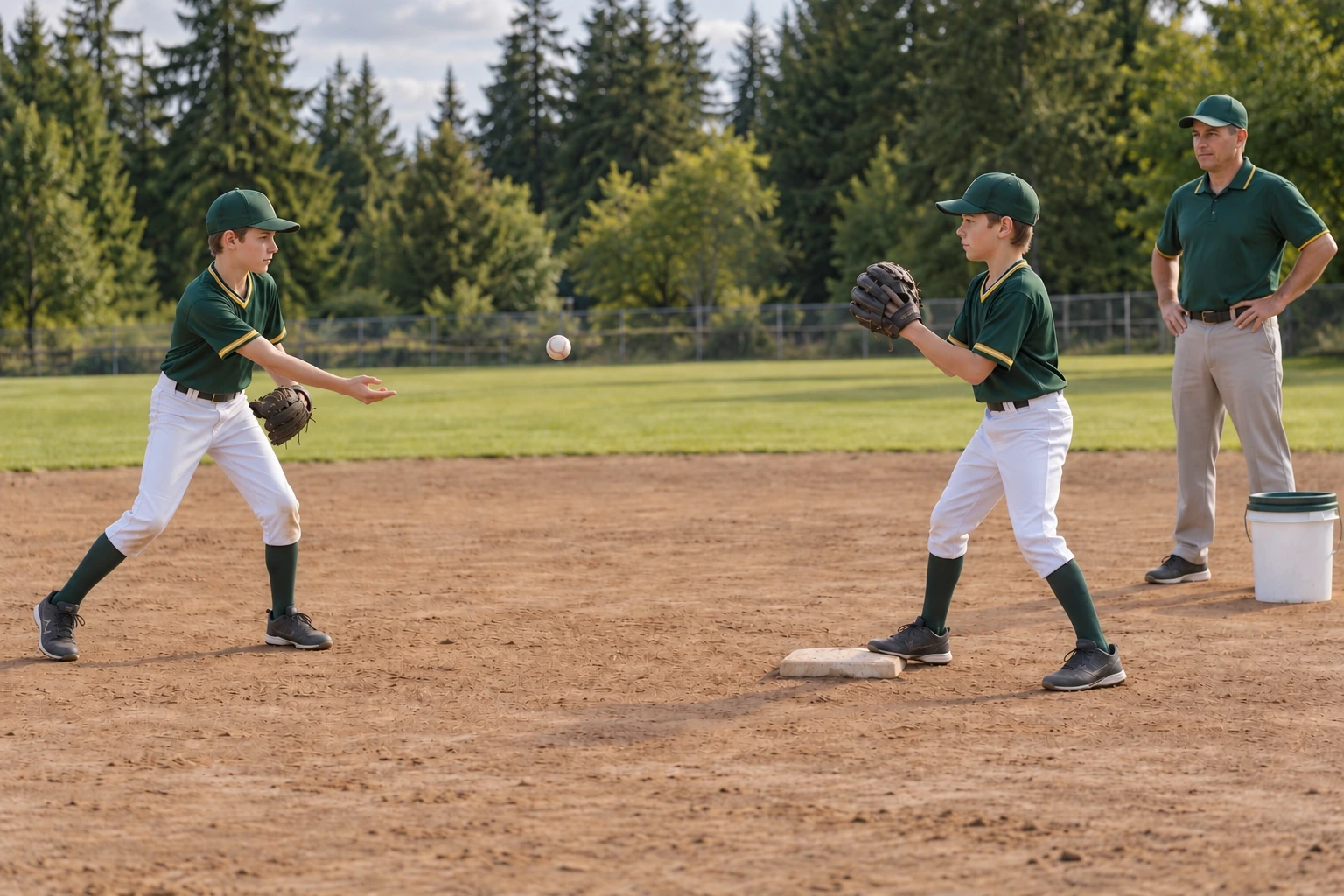
An infielder makes a short underhand feed to a teammate covering second; a coach observes. No runner is visible.
Illustrative short feed toward second. Call a runner-on-first force situation before the rep; no runner is shown. The receiver covers second while securing the ball. Start the rehearsal without a moving runner. This picture does not show a completed out or a removed force.

Recognize an infield fly

With fewer than two outs and runners on first and second, or the bases loaded, a fair fly that an infielder can catch with ordinary effort may be an infield fly. A bunt or line drive is different. Keep playing because the ball stays live.

Make a backup plan

On a bunt, name the charging fielder, the base cover and the backup before the pitch. On any throw, move behind the likely target so a miss does not travel farther.

Practice it here

Point to the covered base before charging a short ball. Ask which Mustang lead choice the league uses before rehearsing a runner leaving a base.

What should you decide before contact? — explanation

Where you will play the ball and who covers the next base. A fielder needs both a first play and the teammate covering the target. Otherwise a good throw can find an empty base.

Which decision protects the defense? — explanation

Take the available out with a controlled throw. Secure the ball and take the out that is still available. A late throw at a runner who is already safe adds risk.

How can the defense retire an off-base runner? — explanation

Tag the runner; the batter's out removed the original force. After an infield-fly batter out, the original force disappears. On a dropped ball, tag an off-base runner instead of just touching the next base.

Which call can apply in this division? — explanation

Infield fly; remain aware that the ball is live. The umpire can call an infield fly under the right outs and runner conditions. The ball stays live, so keep playing.

What makes a coverage plan usable? — explanation

One clear fielder, a covered target and a backup. One fielder takes the short ball, another covers the target and a third backs up. Everyone charging leaves a base open.

How should this defense rehearse a runner holding situation? — explanation

Practice a legal throw and a controlled receiving tag under the stated lead rule. Mustang lead timing depends on the adopted option. Rehearse a legal throw and controlled receiving tag under that option.

Public full lesson (connection required)

Catcher's Command Center

Situation 01

Lead the pre-pitch conversation

Before getting into position, the catcher checks outs, runners and the pitch plan. An infielder confirms coverage for a possible steal.

Where everyone plays: PONY Mustang 10USchematic baseball field, not to scale, home plate at the bottom. Bases are 60 feet apart and the pitching distance is 46 feet. Circles show the nine position numbers: 1 Pitcher; 2 Catcher; 3 First base; 4 Second base; 5 Third base; 6 Shortstop; 7 Left field; 8 Center field; 9 Right field. The double ring marks 2, the catcher.60 ft46 ft1B2B3BHome123456789
Bases 60 ft apart · pitching distance 46 ft · schematic, not to scale. The double ring marks 2, the catcher. Rule source
  1. 1 Pitcher
  2. 2 Catcher
  3. 3 First base
  4. 4 Second base
  5. 5 Third base
  6. 6 Shortstop
  7. 7 Left field
  8. 8 Center field
  9. 9 Right field
What belongs in this check?

Coach answer: Confirm the pitch plan, runners and covered throw target Check the count, runners, pitch plan and covered throw target before the pitch. A late or unseen sign leaves teammates guessing.

Coaching Points

Keep signs simple and confirm that the pitcher can see them.

Common Mistakes

Changing a sign without telling the team creates preventable confusion.

Alternative Considerations

Agree a reset signal for any uncertainty; do not guess at a pitch.

Coaching tip

Situation 02

Keep a blocked ball nearby

At a controlled receiving station, the coach introduces a low ball after checking protective gear and spacing. The catcher works on keeping the ball in front rather than stabbing at it.

What should determine the next progression?

Coach answer: Wait for controlled blocking and a safe recovery Keep the blocked ball close and recover under control before adding speed, a throw or a runner.

Coaching Points

Introduce movement only after comfortable stationary repetitions.

Common Mistakes

A drill is not improved by overwhelming a player with speed.

Alternative Considerations

Return to a softer ball or dry footwork if control breaks down.

Coaching tip

Situation 03

Finish the third strike play

There are two outs and first base is occupied. The catcher does not catch strike three.

May the batter try to reach first?

Coach answer: Yes; with two outs, occupied first does not prevent the attempt The outs and whether first base is occupied determine whether an uncaught third strike lets the batter try for first.

Coaching Points

Recover the ball, identify the available play and communicate. Permission to try is not an award.

Common Mistakes

The occupancy exception changes with the number of outs.

Alternative Considerations

With first occupied and fewer than two outs, the batter is out on the uncaught third strike.

Related rule or safety source: Third Strike

Situation 04

Choose a throw, not a panic

A runner breaks for second. The catcher receives the ball, finds the target and makes a controlled transfer before throwing.

What is the best practice goal?

Coach answer: A repeatable receive-transfer-target sequence Receive, find a clear target, set your feet and throw under control. A hurried throw can give away another base.

Coaching Points

Reward a clean sequence and sound choice, not just a stopwatch result.

Common Mistakes

A rushed throw with no target can create an extra base.

Alternative Considerations

First-and-third situations need a separate team call agreed before the pitch.

Coaching tip

Situation 05

Report a throwing-role change

You caught today and the coach asks whether you can pitch. The PONY rule and your total throwing workload both matter.

What should you do before moving to the mound?

Coach answer: Tell the coach about catching and wait for the PONY rule and workload check Tell the coach about every inning caught before a pitching assignment. Four catching innings in one game bars pitching later that day under Little League rules; PONY uses its own rule.

Coaching Points

The adult checks PONY eligibility and total workload before assigning a role.

Common Mistakes

A position change does not reset fatigue.

Alternative Considerations

A local league may have a stricter rule; report pain and let the adult decide.

Related rule or safety source: Pitching limits Safety

Situation 06

Protect a tired throwing arm

The catcher's throws become less accurate and the player reports fatigue during a practice.

What should the adult do?

Coach answer: Stop the throwing work and reassess the plan A role change does not erase the throws already made. The adult checks the full record and the player's condition.

Coaching Points

Make it easy to report discomfort. Pain requires stopping pitching and appropriate medical evaluation.

Common Mistakes

Changing defensive labels does not remove the work already done.

Alternative Considerations

Use a non-throwing learning role while the adult adjusts activity.

Related rule or safety source: Safety

Learn first

Learn the skill

Read these ideas, then try the situations below. Practice with a coach when a movement is new.

Quiz Mode: try each answer before checking the explanation.

Coach View: use the answers and teaching notes to guide practice.

Prepare every pitch

Before the pitch, check runners, outs and the next possible play. Give the pitcher a clear target while staying ready to move; after a miss, reset and communicate calmly.

Block a ball in the dirt

Move your body behind the ball, lower your center of gravity and try to keep the ball close. Find it before reaching for it; a rushed throw while the ball is loose can turn one base into more.

See example: Receiving and blocking setup
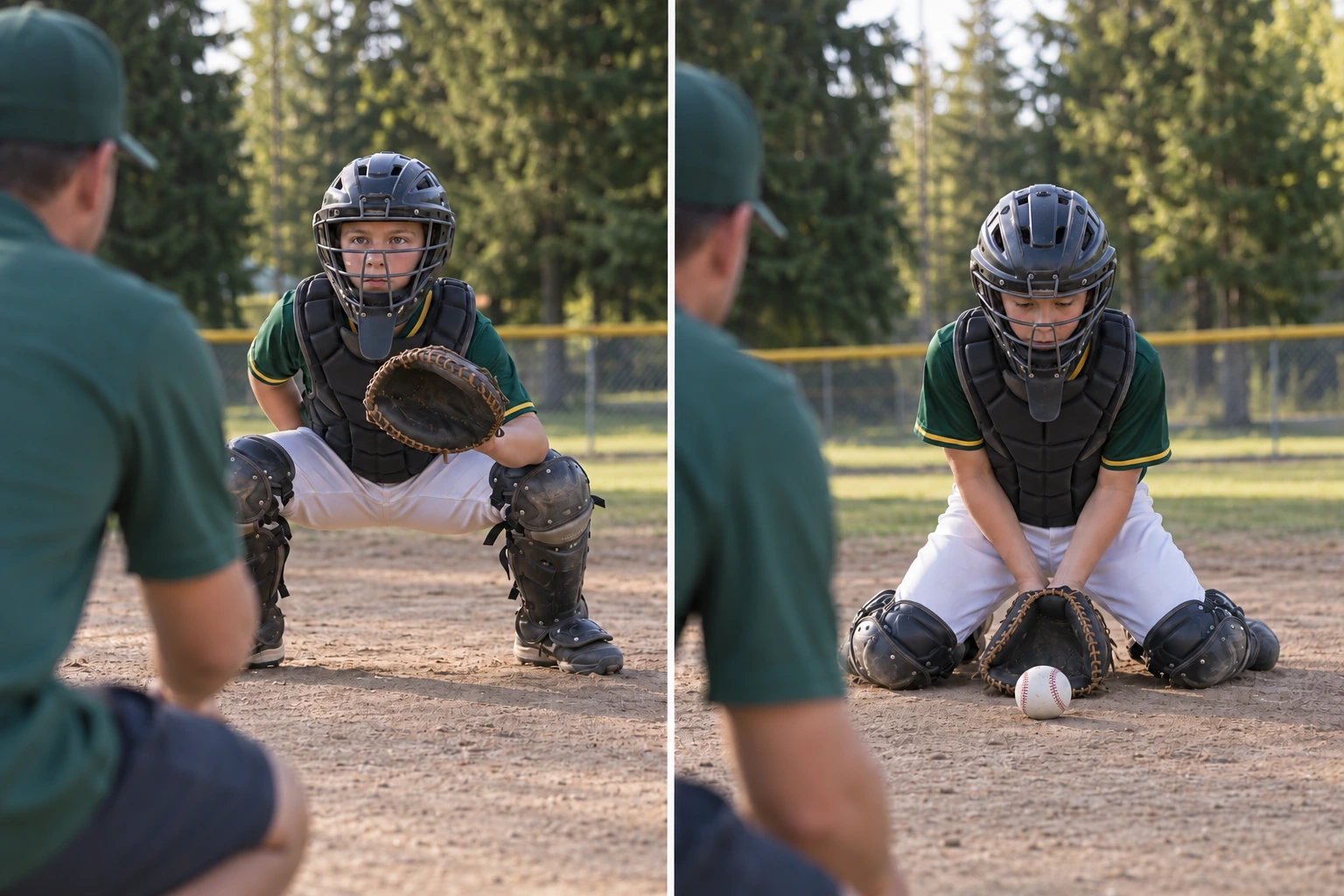
Two views of a young catcher in full gear: receiving target and a kneeling blocking setup with a soft practice baseball resting in front.
Practice setup: receiving target on the left; glove low and body behind a soft practice ball on the right. The second frame is a blocking position, not a completed block or ball trajectory. Use full gear, short supervised sets and age-appropriate movement.

Receive and transfer

Receive the pitch under control. If a runner moves, locate the ball, set your feet toward a clear throwing lane, and make a throw only when the target and timing make sense.

Protect the plate

On a throw home, show the fielder a clear target while leaving a safe path for the runner unless you possess the ball and the rules permit the position. Catch the ball before applying a controlled tag. A late throw may be safer to hold than to chase across the runner's path.

Uncaught third strike

An uncaught third strike can leave the batter able to run when first base is unoccupied, or with two outs even if first is occupied. Know the outs and first-base situation before assuming the batter is out.

Change roles safely

The adult scorekeeper tracks both catching innings and pitching history. Tell the adult about pain or fatigue; never use a completed checklist as medical clearance.

Practice it here

In full catcher gear, block a soft coach-fed pitch toward the middle, find it and reset the target. Add a throw only when an adult confirms safe spacing and a teammate covers the base.

What belongs in this check? — explanation

Confirm the pitch plan, runners and covered throw target. Check the count, runners, pitch plan and covered throw target before the pitch. A late or unseen sign leaves teammates guessing.

What should determine the next progression? — explanation

Wait for controlled blocking and a safe recovery. Keep the blocked ball close and recover under control before adding speed, a throw or a runner.

May the batter try to reach first? — explanation

Yes; with two outs, occupied first does not prevent the attempt. The outs and whether first base is occupied determine whether an uncaught third strike lets the batter try for first.

What is the best practice goal? — explanation

A repeatable receive-transfer-target sequence. Receive, find a clear target, set your feet and throw under control. A hurried throw can give away another base.

What should you do before moving to the mound? — explanation

Tell the coach about catching and wait for the PONY rule and workload check. Tell the coach about every inning caught before a pitching assignment. Four catching innings in one game bars pitching later that day under Little League rules; PONY uses its own rule.

What should the adult do? — explanation

Stop the throwing work and reassess the plan. A role change does not erase the throws already made. The adult checks the full record and the player's condition.

Public full lesson (connection required)

Batted-Ball Priority & Relays

Situation 01

Call the ball early

Two defenders approach a fly. The team's rehearsed priority call identifies the player who will catch it; the other changes to backup.

Where everyone plays: PONY Mustang 10USchematic baseball field, not to scale, home plate at the bottom. Bases are 60 feet apart and the pitching distance is 46 feet. Circles show the nine position numbers: 1 Pitcher; 2 Catcher; 3 First base; 4 Second base; 5 Third base; 6 Shortstop; 7 Left field; 8 Center field; 9 Right field.60 ft46 ft1B2B3BHome123456789
Bases 60 ft apart · pitching distance 46 ft · schematic, not to scale. Rule source
  1. 1 Pitcher
  2. 2 Catcher
  3. 3 First base
  4. 4 Second base
  5. 5 Third base
  6. 6 Shortstop
  7. 7 Left field
  8. 8 Center field
  9. 9 Right field
What should the second player do after yielding?

Coach answer: Communicate and move to a useful backup position The player who yields the catch can still help by calling the play and moving behind the likely miss.

Coaching Points

Rehearse the team's actual priority language before live repetitions.

Common Mistakes

A loud call without a shared meaning is still ambiguous.

Alternative Considerations

Wind, sun and player position can change who has the best play.

Coaching tip

Situation 02

Give the outfielder a target

A ball reaches the gap. The cutoff player moves into line between the outfielder and the called destination, presenting a visible target.

What is the cutoff player's first job?

Coach answer: Create a clear, reachable target on the intended line A clear cutoff target on the intended line gives the outfielder a reachable throw and the defense a next play.

Coaching Points

Have the destination fielder help align the cutoff with a short voice cue.

Common Mistakes

A strong throw can still fail when nobody knows its destination.

Alternative Considerations

The relay may need an extra player for the distance and arm strength available.

Coaching tip

Situation 03

Use a clear cut call

The throw is on its way. The destination fielder sees that holding the trailing runner is now more valuable than a late play at home.

How should the change be communicated?

Coach answer: Use the team's rehearsed cut call and name the new target Name one reachable target before the throw reaches the cutoff. A late or conflicting call leaves the receiver guessing.

Coaching Points

Practice both through and redirected throws at controlled speed.

Common Mistakes

A late or unnamed destination leaves the cutoff guessing.

Alternative Considerations

Agree who has the authority to redirect each relay before the rep.

Coaching tip

Situation 04

Receive ready to throw

A relay player tracks the incoming ball, adjusts the feet and receives under control before turning toward the next target.

What is the useful emphasis?

Coach answer: Secure the ball and move into a balanced throw Catch first, then turn feet toward the next target. Throwing before you are balanced makes the relay less accurate.

Coaching Points

Reduce the distance until the receiving and turn sequence stays controlled.

Common Mistakes

Speeding up an unstable transfer repeats the mistake faster.

Alternative Considerations

A different footwork pattern may suit the throw angle; preserve control.

Coaching tip

Situation 05

Back up the likely miss

A throw is headed to third. A defender who is not receiving it takes a position to stop an overthrow without entering the runner's way.

Where is that defender most useful?

Coach answer: Behind the likely throw path with safe spacing A backup belongs behind the likely missed throw, with enough space to react safely.

Coaching Points

Freeze a rehearsal and ask every player to name a backup responsibility.

Common Mistakes

Watching the main play is not a defensive assignment.

Alternative Considerations

Use the fence and available foul ground to choose a practical backup spot.

Coaching tip

Situation 06

Finish the play together

The lead runner stops, but a trailing runner is still moving. Defenders keep the ball controlled and check all runners before relaxing.

What should end the team's active attention?

Coach answer: The actual play finishing and the next situation being checked The play ends only when the ball and runners are under control under this division's rule. Check every runner before relaxing.

Coaching Points

After each rep, call the new outs and base situation.

Common Mistakes

A relay is not over just because its first target was reached.

Alternative Considerations

Practice a calm hold when no useful throw remains; not every ball needs another throw.

Coaching tip

Learn first

Learn the skill

Read these ideas, then try the situations below. Practice with a coach when a movement is new.

Quiz Mode: try each answer before checking the explanation.

Coach View: use the answers and teaching notes to guide practice.

Give priority a voice

Agree on a team priority before a ball drops between fielders. In this practice plan, the center fielder takes a reachable ball from a corner outfielder, and an outfielder coming in takes a reachable ball from an infielder going back. The fielder who can make the safest play calls loudly and early; the yielding player backs up. A call never makes a collision safe.

Build a relay line

The cutoff player gets between the outfielder and the intended base, gives the outfielder a visible target, and turns feet toward the next throw. The throw should reach a teammate, not just travel as far as possible.

See example: Relay and backup lanes
  1. OutfielderFind a reachable target
  2. Cutoff / relayLine up · secure · turn
  3. Receiving fielderCall the play · secure the throw
  4. BackupBeyond the receiving target
Role diagram only: outfielder → cutoff → receiving fielder, with a backup beyond the receiving target. Read this lesson’s actual situation for the destination, named positions and extra coverage. This diagram does not assign a base or show field distances.

Use one clear decision

A coach or designated fielder calls whether to cut the throw or let it pass. The receiver catches first, checks the runner and then throws if a play remains.

Cover the miss and reset

A backup player moves behind the receiving base. After the immediate play, return the ball under control and confirm where every runner stopped.

Practice it here

Set a nearby cutoff on the 60-foot field, then place a backup behind the base. Walk the sequence before making two controlled throws.

What should the second player do after yielding? — explanation

Communicate and move to a useful backup position. The player who yields the catch can still help by calling the play and moving behind the likely miss.

What is the cutoff player's first job? — explanation

Create a clear, reachable target on the intended line. A clear cutoff target on the intended line gives the outfielder a reachable throw and the defense a next play.

How should the change be communicated? — explanation

Use the team's rehearsed cut call and name the new target. Name one reachable target before the throw reaches the cutoff. A late or conflicting call leaves the receiver guessing.

What is the useful emphasis? — explanation

Secure the ball and move into a balanced throw. Catch first, then turn feet toward the next target. Throwing before you are balanced makes the relay less accurate.

Where is that defender most useful? — explanation

Behind the likely throw path with safe spacing. A backup belongs behind the likely missed throw, with enough space to react safely.

What should end the team's active attention? — explanation

The actual play finishing and the next situation being checked. The play ends only when the ball and runners are under control under this division's rule. Check every runner before relaxing.

Public full lesson (connection required)

Team Offense & Base Coaching

Situation 01

Make the sign clear

The batter and runner both look for the coach's signal before play resumes. A player who missed it uses the agreed reset request.

Around the bases: PONY Mustang 10USchematic baseball field, not to scale, home plate at the bottom. Bases are 60 feet apart and the pitching distance is 46 feet. Numbered arrows show the running order, not when to leave a base: 1 home to first base, 2 first to second, 3 second to third, 4 third to home.60 ft46 ft12341B2B3BHome
Arrows show the running order, not when to leave a base · bases 60 ft apart · pitching distance 46 ft · schematic, not to scale. Rule source
  1. 1 Home to first
  2. 2 First to second
  3. 3 Second to third
  4. 4 Third to home
What is better than guessing?

Coach answer: Asking for the sign again through the team's routine Ask for a sign again through the team's routine rather than guessing and sending teammates different messages.

Coaching Points

Rehearse the reset request as part of the signs, not as a failure.

Common Mistakes

A missed sign can create a safety and coordination problem.

Alternative Considerations

Keep early-season sign sets small; add complexity only when understood.

Coaching tip

Situation 02

Agree on the runner's rule

In this practice, the coach says runners may lead before the pitch. Other Mustang leagues may make runners wait; ask which rule your team uses.

What must the base coach establish before a lead-off drill?

Coach answer: The applicable departure rule and a lead the runner can control Ask which Mustang departure option applies, then take only a lead you can control.

Coaching Points

Have the runner repeat the rule and the return cue before adding a live pitcher.

Common Mistakes

Familiar PONY branding does not erase Mustang's national menu of local options.

Alternative Considerations

For a more restricted Mustang option, teach its timing at the affected base rather than practicing an illegal early departure.

Related rule or safety source: Leaving a base Leaving a base

Situation 03

Give a runner one decision

A third-base coach sees the ball, relay and runner approaching. The coach uses the team's agreed stop or send signal clearly and early.

What is the coaching priority?

Coach answer: A visible, timely decision the runner can follow An early, visible stop or go call gives the runner time to act before a throw reaches the base.

Coaching Points

Practice communication with a jogging runner before adding a live relay.

Common Mistakes

Conflicting voice and hand signals make the decision harder.

Alternative Considerations

Aggressiveness depends on score, outs and player readiness; it is not a universal send rule.

Coaching tip

Situation 04

Name the contact-play plan

Before a situational rep, the coach tells the runner whether to read the ball first or act on a specific contact cue. Everyone repeats the instruction.

Which version is teachable?

Coach answer: Name the cue, the safe fallback and who communicates it A contact play needs one cue, a safe fallback and a person who gives the call. The runner can then react consistently.

Coaching Points

Walk the scenario and then ask what changes on a line drive or a missed sign.

Common Mistakes

A slogan is not a complete base-running decision.

Alternative Considerations

Do not run a high-risk team play until the simpler read is reliable.

Coaching tip

Situation 05

React to an uncaught third strike

First base is empty with one out. Strike three is not caught. In this PONY division, an uncaught third strike lets the batter try for first when first base is empty or there are two outs.

What should the batter recognize?

Coach answer: There is a permitted attempt to reach first, not an automatic award Check the outs, first base and the governing local instruction before deciding what follows this pitch.

Coaching Points

Make the first-base and outs check part of a short batter/catcher scenario.

Common Mistakes

Do not teach a younger-division exemption as if it applied to this division.

Alternative Considerations

Change the setup to occupied first with fewer than two outs and ask why the result changes.

Related rule or safety source: Third Strike

Situation 06

Follow the station instruction

At this academy's bunt station, the coach asks players to choose a committed bunt or a normal swing, not a fake bunt followed by a full swing. The actual game rule is checked separately.

What should a player do at this station?

Coach answer: Follow the station instruction and ask which game rule applies before play Follow the coached station instruction. Before a game, ask which written batting rule applies to this division.

Coaching Points

Explain the station's conservative boundary without attaching an unsupported penalty.

Common Mistakes

A coaching preference is not a national rule.

Alternative Considerations

Follow an actual adopted restriction where it applies; do not infer one from another league.

Coaching tip

Learn first

Learn the skill

Read these ideas, then try the situations below. Practice with a coach when a movement is new.

Quiz Mode: try each answer before checking the explanation.

Coach View: use the answers and teaching notes to guide practice.

Share a simple plan

Before the pitch, the hitter, runner and base coach should know the sign and the likely next decision. A sign is useful only if everyone understands it.

Coach safely from the box

A base coach starts inside the coach's box and leaves only as the governing rule permits for a play at that base. A player serving as base coach wears a protective helmet. Give a voice or hand signal; do not push, hold or touch a runner to help them advance or return, because physical assistance can put the runner out.

Coach one decision at a time

A base coach watches the ball and fielders, then gives an early, clear stop or go call. A runner also watches the ball and must not wait until a throw is already arriving to decide.

See example: A clear base-coach decision
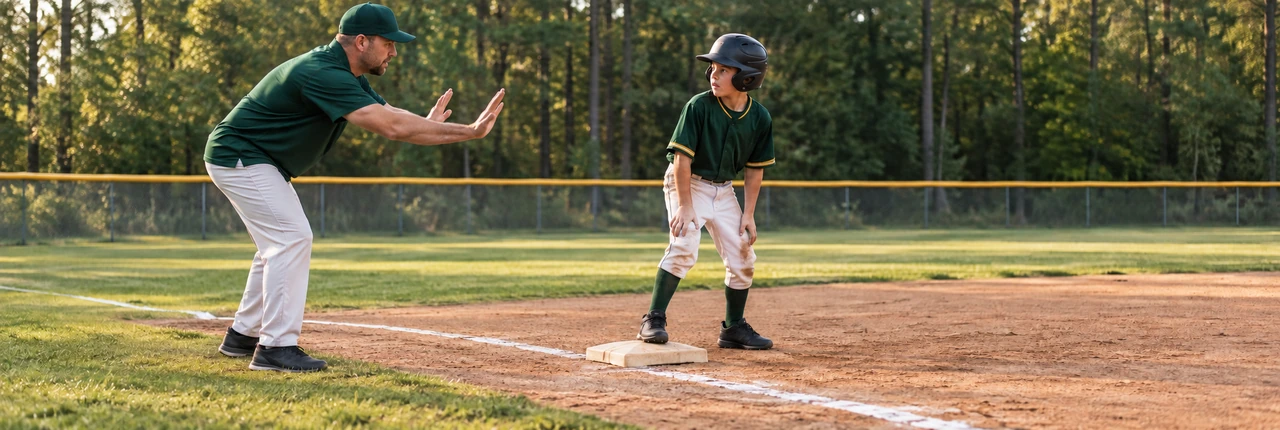
A base coach gives a hold signal while a helmeted runner responds.
Example hold decision. Use the agreed signal and watch the ball, outs and runner. This picture illustrates communication, not permission to leave a base before this division allows it.

Match contact to the situation

With a runner at third, talk through a ground ball, a caught fly and a ball through the infield. The number of outs changes whether the runner can advance safely.

Finish the live play

On a possible uncaught third strike, check the outs and first-base occupancy. Do not leave the field or assume the ball is dead until the play is over.

Practice it here

Give one clear sign to the hitter and runner. Ask the coach which lead choice applies, then practice an early stop or go call without touching the runner.

What is better than guessing? — explanation

Asking for the sign again through the team's routine. Ask for a sign again through the team's routine rather than guessing and sending teammates different messages.

What must the base coach establish before a lead-off drill? — explanation

The applicable departure rule and a lead the runner can control. Ask which Mustang departure option applies, then take only a lead you can control.

What is the coaching priority? — explanation

A visible, timely decision the runner can follow. An early, visible stop or go call gives the runner time to act before a throw reaches the base.

Which version is teachable? — explanation

Name the cue, the safe fallback and who communicates it. A contact play needs one cue, a safe fallback and a person who gives the call. The runner can then react consistently.

What should the batter recognize? — explanation

There is a permitted attempt to reach first, not an automatic award. Check the outs, first base and the governing local instruction before deciding what follows this pitch.

What should a player do at this station? — explanation

Follow the station instruction and ask which game rule applies before play. Follow the coached station instruction. Before a game, ask which written batting rule applies to this division.

Public full lesson (connection required)

Base Running & Base Stealing

Situation 01

Identify this division's departure rule

A Mustang team is preparing for its first game. The coach has not yet said whether runners may leave before the pitch.

Around the bases: PONY Mustang 10USchematic baseball field, not to scale, home plate at the bottom. Bases are 60 feet apart and the pitching distance is 46 feet. Numbered arrows show the running order, not when to leave a base: 1 home to first base, 2 first to second, 3 second to third, 4 third to home.60 ft46 ft12341B2B3BHome
Arrows show the running order, not when to leave a base · bases 60 ft apart · pitching distance 46 ft · schematic, not to scale. Rule source
  1. 1 Home to first
  2. 2 First to second
  3. 3 Second to third
  4. 4 Third to home
Which statement is correct?

Coach answer: Ask the coach which Mustang lead choice applies before leaving a base Mustang leagues can adopt different lead choices. Ask which one applies before leaving a base.

Coaching Points

Option (1) is unrestricted; option (2) restricts third; option (3) restricts departure from every occupied base. Tournament play uses option (1).

Common Mistakes

Never turn a rule from another division into this runner's instruction.

Alternative Considerations

The coach can reduce a training lead for readiness without presenting that choice as a national requirement.

Related rule or safety source: Leaving a base Leaving a base

Situation 02

Read under the stated option

In this practice, the coach says runners may lead before the pitch. Other Mustang leagues may make runners wait; ask which rule your team uses.

In this unrestricted-lead exercise, what guides the first move?

Coach answer: A practiced read that distinguishes delivery from a legal throw over Watch the ball and the legal timing before committing. Guessing at a pitcher's first motion can send you into a tag.

Coaching Points

Demonstrate slowly and ask the runner what was observed before adding speed.

Common Mistakes

Guessing on every motion is not the same as reading a pitcher.

Alternative Considerations

Under restricted Mustang options, satisfy the legal departure time first; do not reuse an unrestricted first-move cue.

Related rule or safety source: Leaving a base Leaving a base

Situation 03

Keep the next movement legal

Your Mustang team makes runners wait on the occupied base until the pitch reaches or passes the batter. Then you read the ball.

What is the useful movement goal?

Coach answer: Follow the legal timing and stay balanced to advance or return Stay balanced enough to advance when the ball gets away or return when the defense has a play.

Coaching Points

Practice both the advance and return from a balanced position.

Common Mistakes

Movement that looks quick can still be illegal or uncontrolled.

Alternative Considerations

Coach the actual rule and the runner's readiness together; neither replaces the other.

Related rule or safety source: Leaving a base

Situation 04

Respect a caught fly

An infield fly is declared and then caught. You are a runner deciding whether to advance.

What still matters?

Coach answer: The catch still creates retouch responsibilities If a fly is caught, retouch your original base before advancing. The infield-fly call does not cancel a real catch.

Coaching Points

Read the catch separately from the batter-out call and listen to the base coach.

Common Mistakes

An infield-fly call is not permission to ignore the catch.

Alternative Considerations

Walk through a ball that drops untouched too; do not treat caught and dropped versions as identical.

Related rule or safety source: Infield fly

Situation 05

Run through the coach's picture

On an extra-base chance, find the base coach early enough to act on the agreed signal. Touch the base under control and keep awareness of the ball.

What should a practice rep include?

Coach answer: A clear stop or continue signal and a controlled turn A controlled turn keeps the next base in view while giving you time to follow the coach's stop or continue call.

Coaching Points

Start at a jog, then add speed when the runner reads the signal reliably.

Common Mistakes

A fast turn without a read can send the runner into a bad decision.

Alternative Considerations

Field conditions and player confidence may require a slower progression.

Coaching tip

Situation 06

Return under control

In a supervised return drill, the pitcher makes a legal throw to first while you are a few steps off the base. You need to get back without colliding with another player.

What is the priority when rehearsing the return on a legal throw?

Coach answer: A controlled return with safe spacing Return with your eyes on the ball and room to slide or stop safely. Do not drift farther while the defense controls it.

Coaching Points

Begin without a live tag; add a controlled throw only after the return is understood.

Common Mistakes

Permission to lead does not guarantee every lead or return is safe.

Alternative Considerations

Use a conservative return technique taught by the coach; do not turn a training preference into a borrowed national sliding rule.

Related rule or safety source: Leaving a base Leaving a base

Learn first

Learn the skill

Read these ideas, then try the situations below. Practice with a coach when a movement is new.

Quiz Mode: try each answer before checking the explanation.

Coach View: use the answers and teaching notes to guide practice.

Know when you may leave

Before every pitch, know this division's lead and steal rule. A rule for another division can change the entire play.

Read the ball first

On a ground ball, look at its direction and the coach's signal. On a fly, see whether it is caught. If it is caught, retouch your original base before advancing. If it drops, read the live ball and the coach before moving.

See example: Running through first
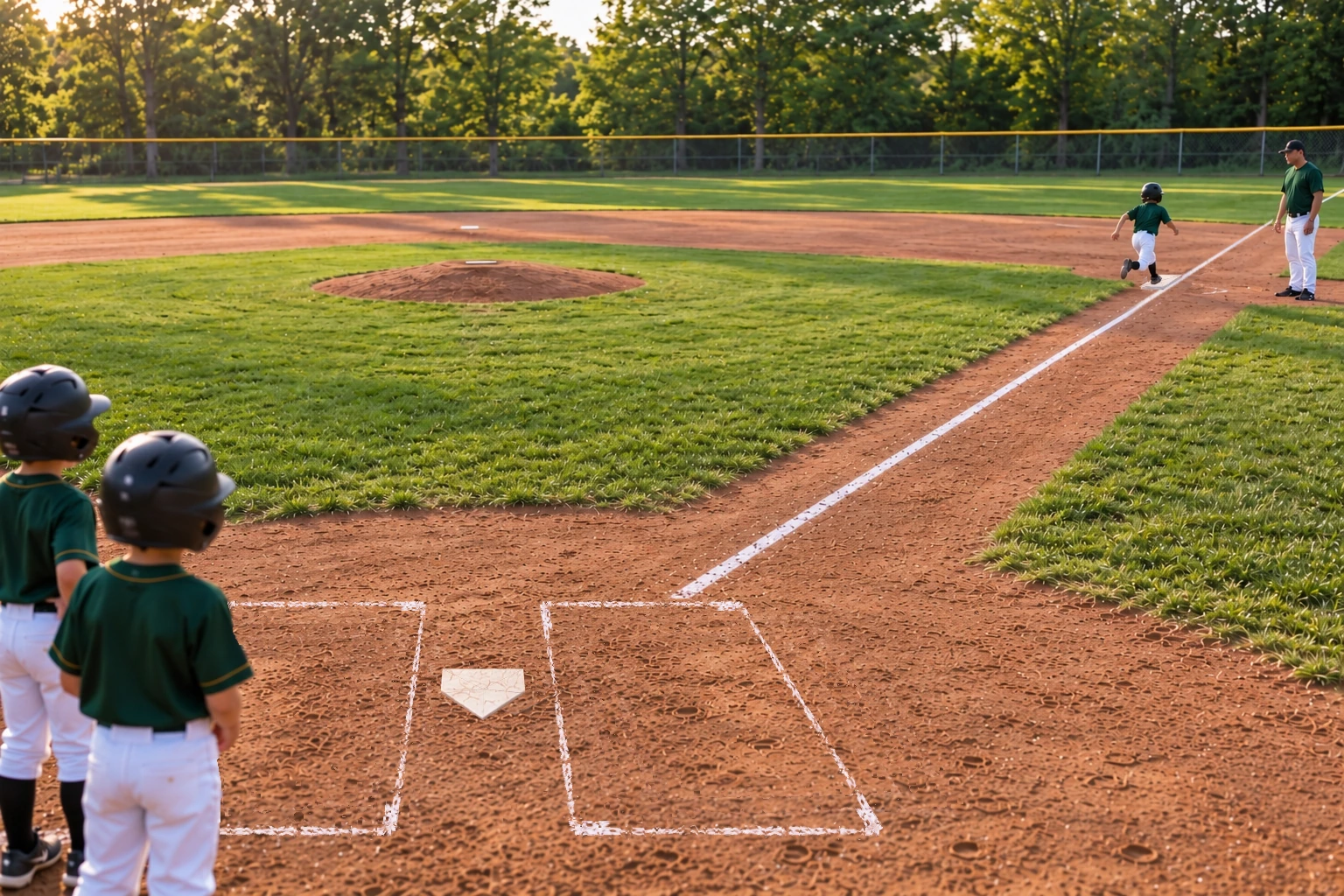
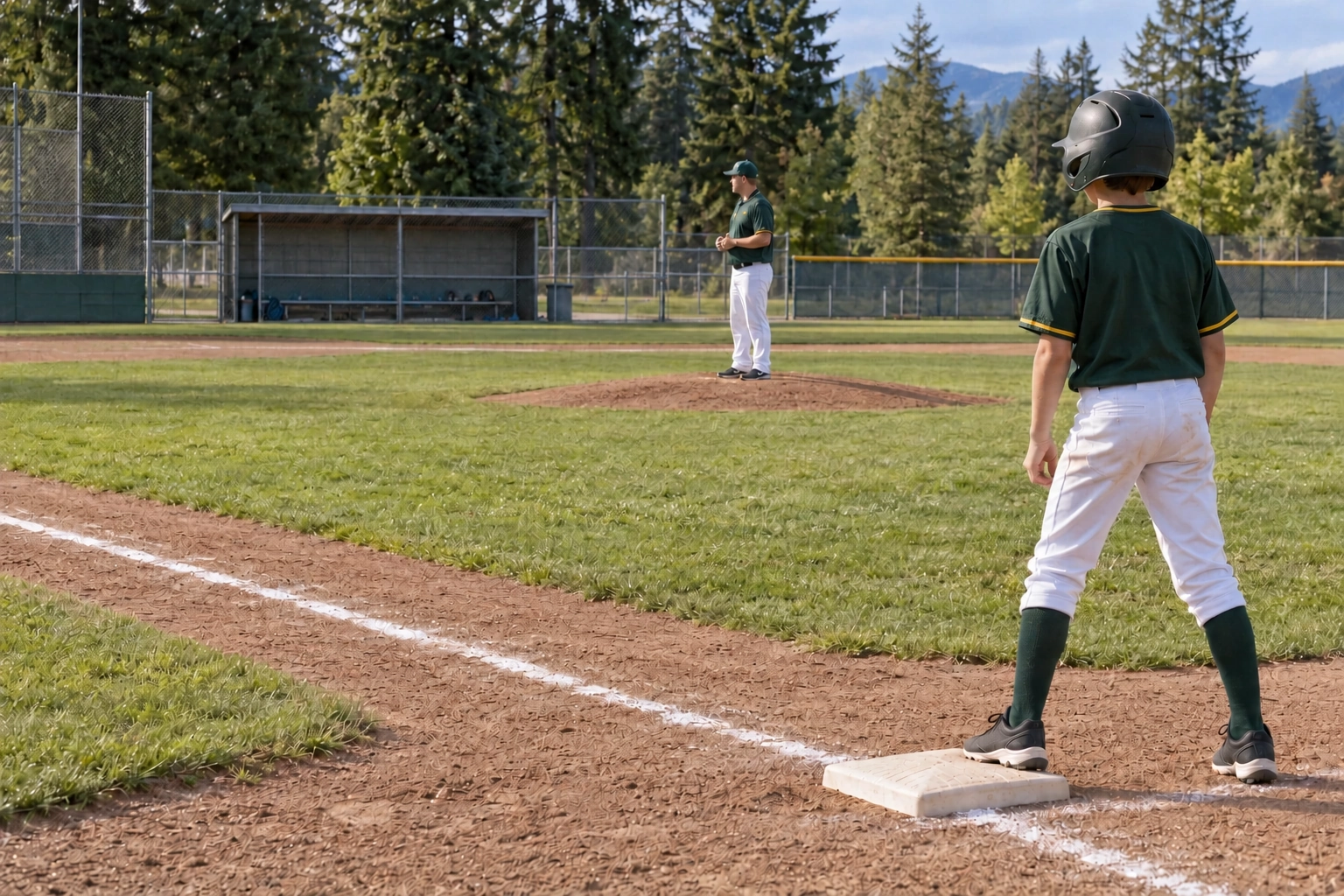
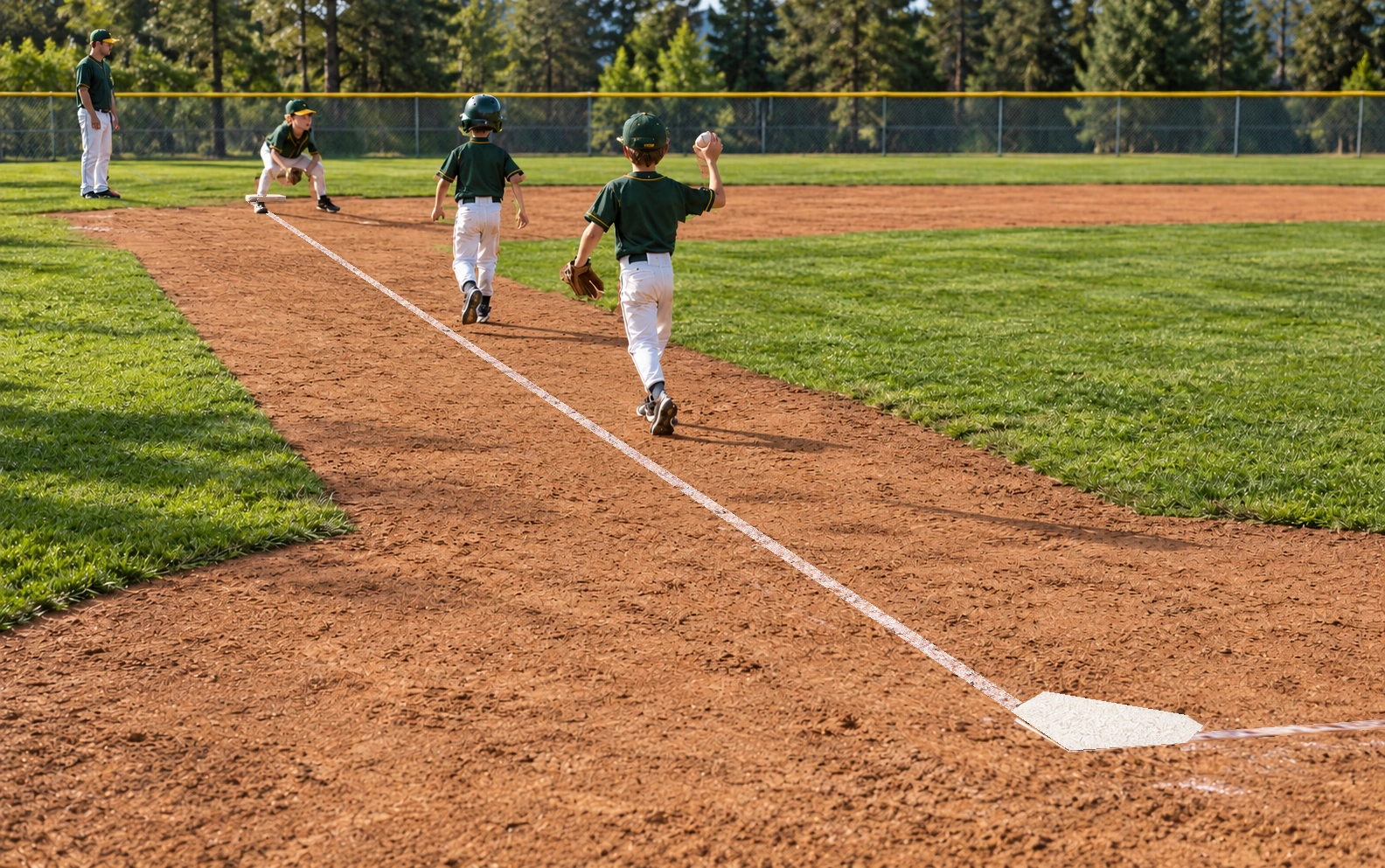
A helmeted runner moves from home toward and through first base.
Run-through example: touch first and continue beyond it before slowing. This picture does not show rounding, returning or retouching. Follow the lesson for those different decisions.
See example: Waiting on a fly-ball read
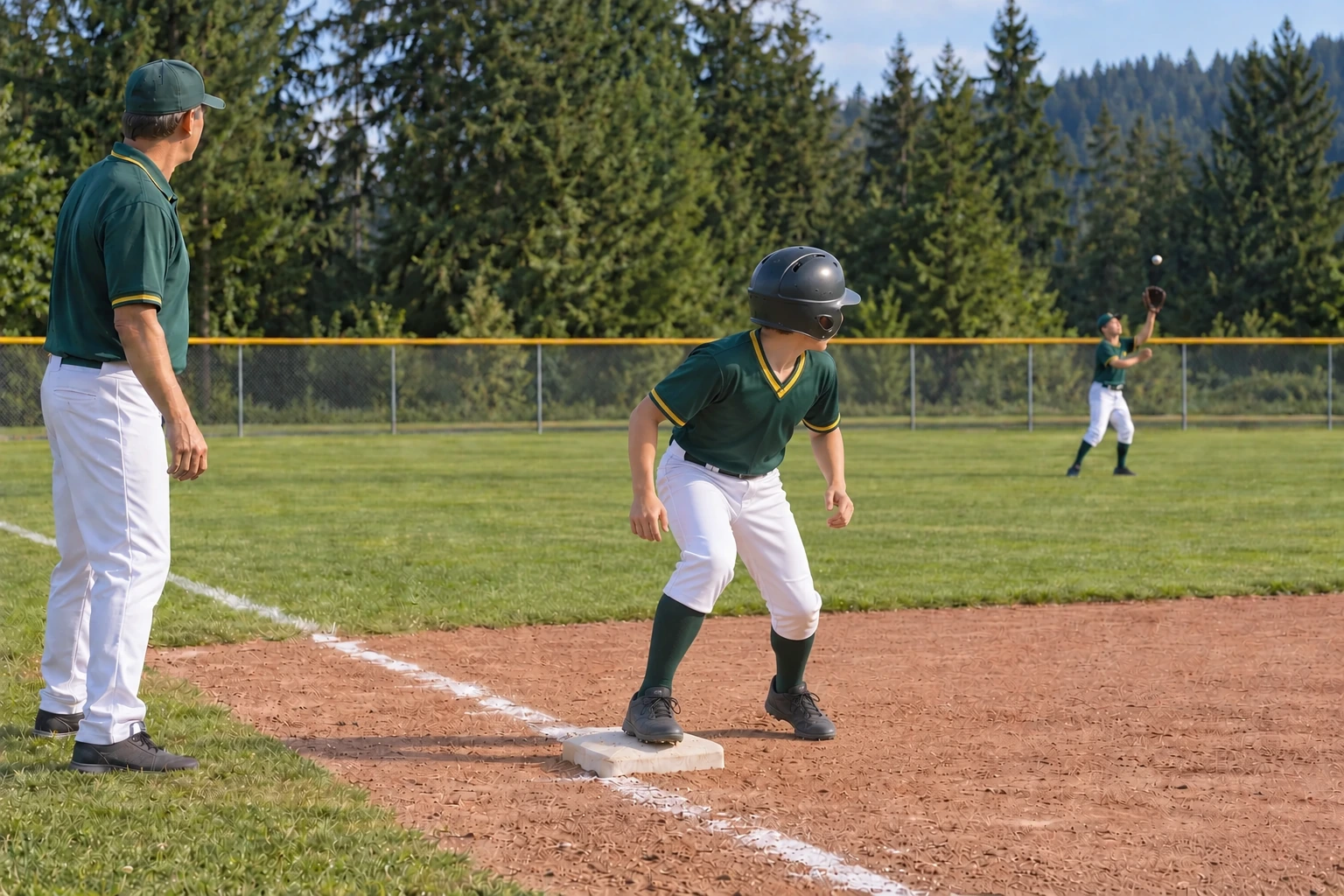
A helmeted runner stays in contact with third while a fly ball is still above the outfielder glove; a coach stays clear.
Before first touch: the runner remains in contact with the base while watching the approaching fly ball. The picture does not show a catch, departure or scoring decision. Read the lesson for retouch and permitted advance timing.

Move with control

Take a secondary move only when it is legal and manageable. Round a base while looking at the next play, then return promptly when the defense has the ball.

Practice a rundown

When caught between bases, keep your eyes on the ball, choose a base and run decisively. Do not turn away from a throw you cannot see.

Practice it here

Practice a safe return to the bag first. Then use the league's adopted lead choice to decide when a runner may leave; do not copy a teammate's rule from another league.

Which statement is correct? — explanation

Ask the coach which Mustang lead choice applies before leaving a base. Mustang leagues can adopt different lead choices. Ask which one applies before leaving a base.

In this unrestricted-lead exercise, what guides the first move? — explanation

A practiced read that distinguishes delivery from a legal throw over. Watch the ball and the legal timing before committing. Guessing at a pitcher's first motion can send you into a tag.

What is the useful movement goal? — explanation

Follow the legal timing and stay balanced to advance or return. Stay balanced enough to advance when the ball gets away or return when the defense has a play.

What still matters? — explanation

The catch still creates retouch responsibilities. If a fly is caught, retouch your original base before advancing. The infield-fly call does not cancel a real catch.

What should a practice rep include? — explanation

A clear stop or continue signal and a controlled turn. A controlled turn keeps the next base in view while giving you time to follow the coach's stop or continue call.

What is the priority when rehearsing the return on a legal throw? — explanation

A controlled return with safe spacing. Return with your eyes on the ball and room to slide or stop safely. Do not drift farther while the defense controls it.

Public full lesson (connection required)

Pitching: Grips, Mechanics & Strategy

Section 01

Start with readiness

Before throwing, tell the adult about fatigue or elbow/shoulder pain. Pain is a reason to stop pitching and seek medical evaluation, not a cue to push through.

I checked readiness with my coach before this supervised practice.

Coaching Points

Use a calm check-in that makes reporting symptoms easy.

Common Mistakes

Do not turn a checked box into medical clearance.

Alternative Considerations

A player can take part in non-throwing learning while an adult arranges appropriate care.

Related rule or safety source: Safety

Section 02

Explore fastball and changeup grips

With a ball in hand and no throw, compare a comfortable fastball grip and a coach-taught changeup grip. Basic throwing comes first; a grip is not a promise of velocity.

I compared the grips under supervision without forcing a painful hand position.

Coaching Points

Start with the player's hand size and comfortable control.

Common Mistakes

Do not force a professional grip on a smaller hand.

Alternative Considerations

This lesson does not prescribe a breaking-ball or weighted-ball program.

Related rule or safety source: Safety

Section 03

Find a repeatable start

During a dry rehearsal, establish balance before moving toward the target. Keep the practice cue simple enough to repeat.

I rehearsed a balanced starting position with my coach.

Coaching Points

Observe the whole movement before adding another cue.

Common Mistakes

A pose that looks right is not proof of a comfortable throw.

Alternative Considerations

Use individual coaching for a persistent movement problem.

Related rule or safety source: Safety

Section 04

Rehearse the legal set

With runners aboard, rehearse a complete legal stop in the set position before delivery.

I demonstrated a controlled set-position stop under supervision.

Coaching Points

Separate a legal delivery from a legal base throw; begin without live runners.

Common Mistakes

Do not import the Little League Majors no-stop exemption.

Alternative Considerations

Mustang departure restrictions do not license illegal pitching mechanics. PONY does not use MLB's pitch clock or disengagement limit.

Related rule or safety source: Balk Leaving a base

Section 05

Use a controlled target

In a coach-approved throwing progression, aim for a reachable target and prioritize a comfortable repeatable motion over a radar-gun number.

I used the agreed target and stopped when control or comfort changed.

Coaching Points

Keep the emphasis on a sound basic throw, then fastball and changeup development.

Common Mistakes

Do not add maximum-effort throws to chase a screen score.

Alternative Considerations

The checklist records a learning step, not prescribed repetitions or exercise dosage.

Related rule or safety source: Safety

Section 06

Check the whole day before pitching

The adult reviews league age, all same-day pitching, required rest and readiness. PONY can permit pitching in more than one game on a day within its combined maximum.

I asked the adult to verify the complete day's workload and eligibility.

Coaching Points

Use PONY 10(D)-(I), including its final-batter provisions and ban on same-game pitcher return.

Common Mistakes

A second game is not a new pitch allowance, and numerical eligibility is not medical clearance.

Alternative Considerations

Use the actual game record; these learning checkboxes do not store a pitch log.

Related rule or safety source: Pitching limits Rest Pitching limits Safety

Section 07

Finish and report

After the practice, tell the coach how the arm feels and discuss the next throwing day using the adult's workload record.

I completed the post-practice check-in and know to report pain or fatigue.

Coaching Points

Coordinate all throwing commitments rather than treating each team in isolation.

Common Mistakes

Completing all boxes is not permission for another throwing session.

Alternative Considerations

Keep regular off-season rest and varied non-throwing activity in the longer plan.

Related rule or safety source: Safety

Learn first

Learn the skill

Read these ideas, then try the situations below. Practice with a coach when a movement is new.

Quiz Mode: try each answer before checking the explanation.

Coach View: use the answers and teaching notes to guide practice.

Start with a comfortable throw

Warm up under an adult's plan. Use an easy, balanced motion toward a reachable target before adding intensity. Stop and tell the adult about elbow or shoulder pain.

Hold the ball without forcing a grip

For a basic four-seam fastball, place fingers across the seams with a relaxed hand and comfortable thumb support. A two-seam grip follows the paired seams. Hand size can change the exact placement.

Learn a changeup gradually

A coach can show a comfortable changeup grip that looks like a fastball delivery but moves at a different speed. Control and a pain-free motion matter more than forcing a particular grip.

Connect the delivery

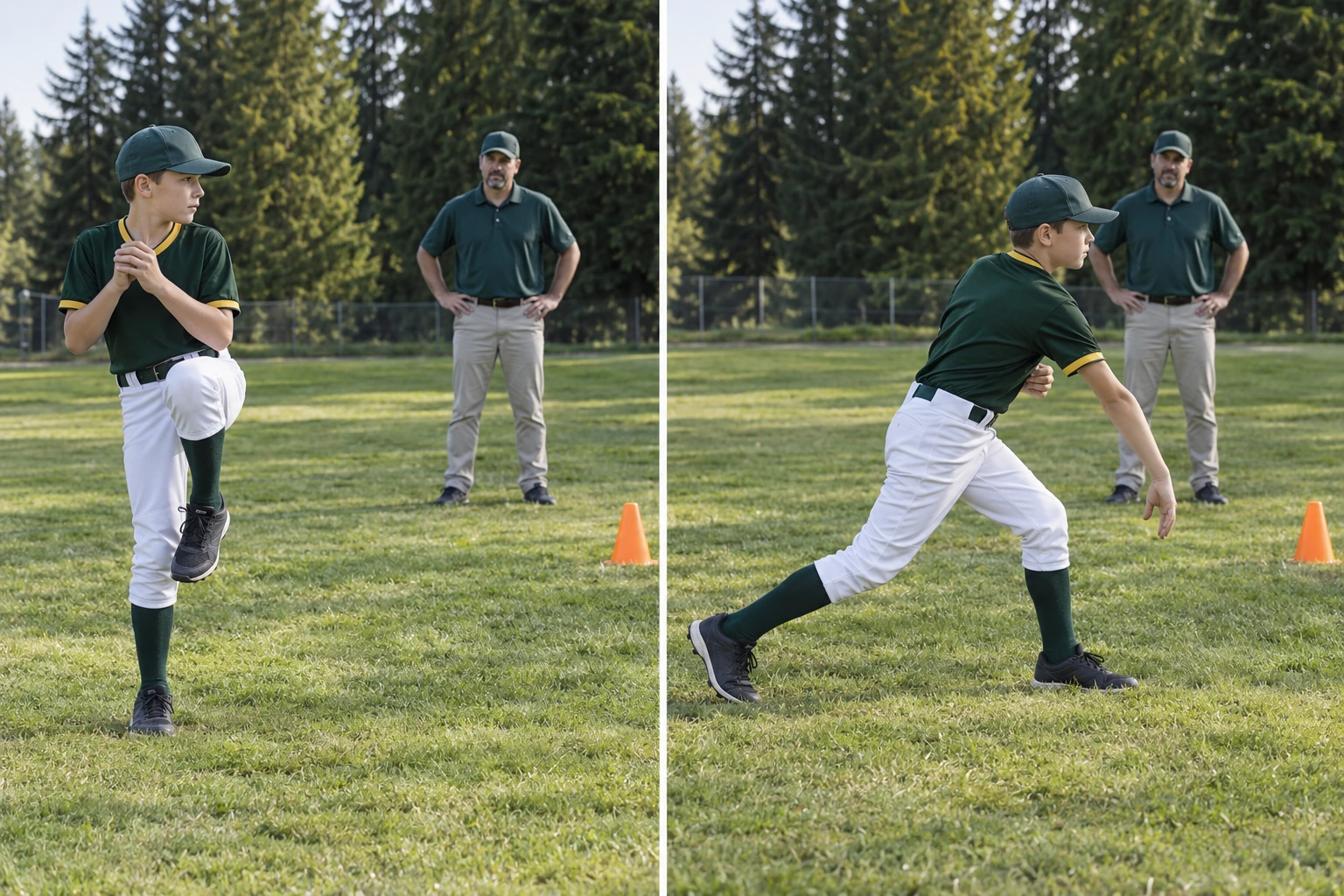
Begin balanced, move toward the target, rotate through the throw and finish under control. Rehearse without a ball, then throw at a comfortable effort. A legal set or windup depends on the division and game situation.

Finish with a check-in

The adult records actual pitches and catching use; this checklist is only a learning record. Report fatigue or pain and follow the adult's rest plan.

Practice it here

Begin from the 46-foot distance with easy balance and target throws. Check comfort before adding a changeup grip or longer set.

Public full lesson (connection required)

Arm Strengthening & Injury Prevention

Situation 01

Respond to pain

A player reports elbow pain during throwing. The training decision must protect the player even if a game is close.

What is the right response?

Coach answer: Stop pitching and arrange sports-medicine evaluation Elbow or shoulder pain means stop throwing and tell an adult. Throwing harder or hiding pain can worsen an injury.

Coaching Points

Let the player report symptoms without losing face.

Common Mistakes

No scoreboard result justifies pitching through elbow or shoulder pain.

Alternative Considerations

This training module cannot diagnose an injury or clear a return.

Related rule or safety source: Safety

Situation 02

Treat the limit as a ceiling

The pitcher looks tired and accuracy drops before the daily maximum is reached.

What does the numerical limit mean?

Coach answer: An eligibility ceiling, not a reason to keep a tired player throwing A legal maximum is a ceiling. A tired player may need to stop before reaching it.

Coaching Points

Respond to fatigue and review all throwing, not only counted game pitches.

Common Mistakes

A legal count is not a guarantee of readiness.

Alternative Considerations

Choose rest and a non-throwing learning role when needed.

Related rule or safety source: Pitching limits Safety

Situation 03

Count complete rest days

A league-age 10 pitcher finishes Monday with 40 pitches; the final at-bat began within the 36-50 band and no threshold exception changes that band.

What does PONY's table require before another pitching day?

Coach answer: Two calendar days of rest Count full calendar days after pitching; the game day itself is not a rest day. Use the actual pitch band.

Coaching Points

Tuesday and Wednesday are rest days in this example. Check every other eligibility and readiness condition too.

Common Mistakes

The pitching day does not count as a completed rest day.

Alternative Considerations

For a threshold-spanning final batter, use 10(D)'s start-of-at-bat provision and its removal-before-next-batter condition.

Related rule or safety source: Rest

Situation 04

Coordinate all teams

A player has school, league and practice throwing commitments. Adults compare schedules before adding work.

What is the useful approach?

Coach answer: Coordinate the full workload and avoid overlapping pitching demands Throws for every team use the same arm. Adults need the full schedule to plan rest.

Coaching Points

Share the workload with responsible adults without putting identifying health details in training notes.

Common Mistakes

Separate uniforms do not create separate recovery.

Alternative Considerations

The eligibility rules and the safety plan both need attention.

Related rule or safety source: Safety

Situation 05

Choose a supervised strength step

A player wants to add strength work after practice. The coach offers a short, age-appropriate movement routine; the player's arm is pain-free.

What should the player do?

Coach answer: Follow the supervised plan and stop if arm pain begins Use a supervised plan suited to you and stop for pain. A checklist or teammate's program cannot clear an injury.

Coaching Points

Choose qualified instruction appropriate to the player's development.

Common Mistakes

A video or checklist cannot evaluate an individual injury.

Alternative Considerations

Stop an activity that causes pain; get qualified advice before resuming.

Related rule or safety source: Safety

Situation 06

Plan time away from throwing

The family and coach look beyond this week's games. Recovery planning includes an off-season and other enjoyable physical activities.

Which long-term plan fits the safety guidance?

Coach answer: Plan four months off throwing yearly and enjoy other sports Four months away from throwing each year helps protect recovery; other sports can stay enjoyable.

Coaching Points

Discuss ASMI's published off-season recommendations with the responsible adults.

Common Mistakes

Calling a session optional does not remove its throwing load.

Alternative Considerations

Age-specific guidance and the player's clinician may require a more conservative plan.

Related rule or safety source: Safety

Learn first

Learn the skill

Read these ideas, then try the situations below. Practice with a coach when a movement is new.

Quiz Mode: try each answer before checking the explanation.

Coach View: use the answers and teaching notes to guide practice.

Pain changes the plan

Elbow or shoulder pain means stop throwing and tell a responsible adult. Do not try to throw through it or use medicine to keep pitching. A clinician evaluates an injury and return.

A limit is a ceiling

The legal pitch maximum does not promise that every pitch below it is safe. If control, movement or comfort changes, tell the adult and stop or adjust.

Count recovery days

Rest is measured in full calendar days after pitching, using the governing program's age and pitch bands. For example, if two days of rest follow a Monday outing, Tuesday and Wednesday are rest days. The adult checks the official pitching record and any final-batter exception before another outing.

Build the whole athlete

Use age-appropriate, supervised movement, strength and recovery work. No single drill guarantees injury prevention or more speed; do not copy a weighted-ball prescription from a page.

Coordinate the calendar

School, club, league and practice throws all use the same arm. Pitch Smart recommends at least four months off throwing each year, with two to three months in one stretch. It also recommends combined pitching limits of 60 innings for ages 8 and under, 80 for ages 9–12, and 100 for ages 13–14 in any 12 months. These are health guidelines; an adult tracks the calendar across teams and checks the governing game rules separately.

Practice it here

After each controlled throwing set, report pain or loss of control. The adult compares actual pitches with PONY age limits and rest before another outing.

What is the right response? — explanation

Stop pitching and arrange sports-medicine evaluation. Elbow or shoulder pain means stop throwing and tell an adult. Throwing harder or hiding pain can worsen an injury.

What does the numerical limit mean? — explanation

An eligibility ceiling, not a reason to keep a tired player throwing. A legal maximum is a ceiling. A tired player may need to stop before reaching it.

What does PONY's table require before another pitching day? — explanation

Two calendar days of rest. Count full calendar days after pitching; the game day itself is not a rest day. Use the actual pitch band.

What is the useful approach? — explanation

Coordinate the full workload and avoid overlapping pitching demands. Throws for every team use the same arm. Adults need the full schedule to plan rest.

What should the player do? — explanation

Follow the supervised plan and stop if arm pain begins. Use a supervised plan suited to you and stop for pain. A checklist or teammate's program cannot clear an injury.

Which long-term plan fits the safety guidance? — explanation

Plan four months off throwing yearly and enjoy other sports. Four months away from throwing each year helps protect recovery; other sports can stay enjoyable.

Public full lesson (connection required)

Complete drill instructions

Dynamic warm-up

Warm-up · About 8 minutes · 1-30 players per group · 1 approved adult · Space: Small safe space (no field)

Goal: Raise body temperature and move every joint before anyone throws or swings.

Setup: Two cones about 20 steps apart. Players in lines of three or four, all facing the same way.

Equipment: 4 cones

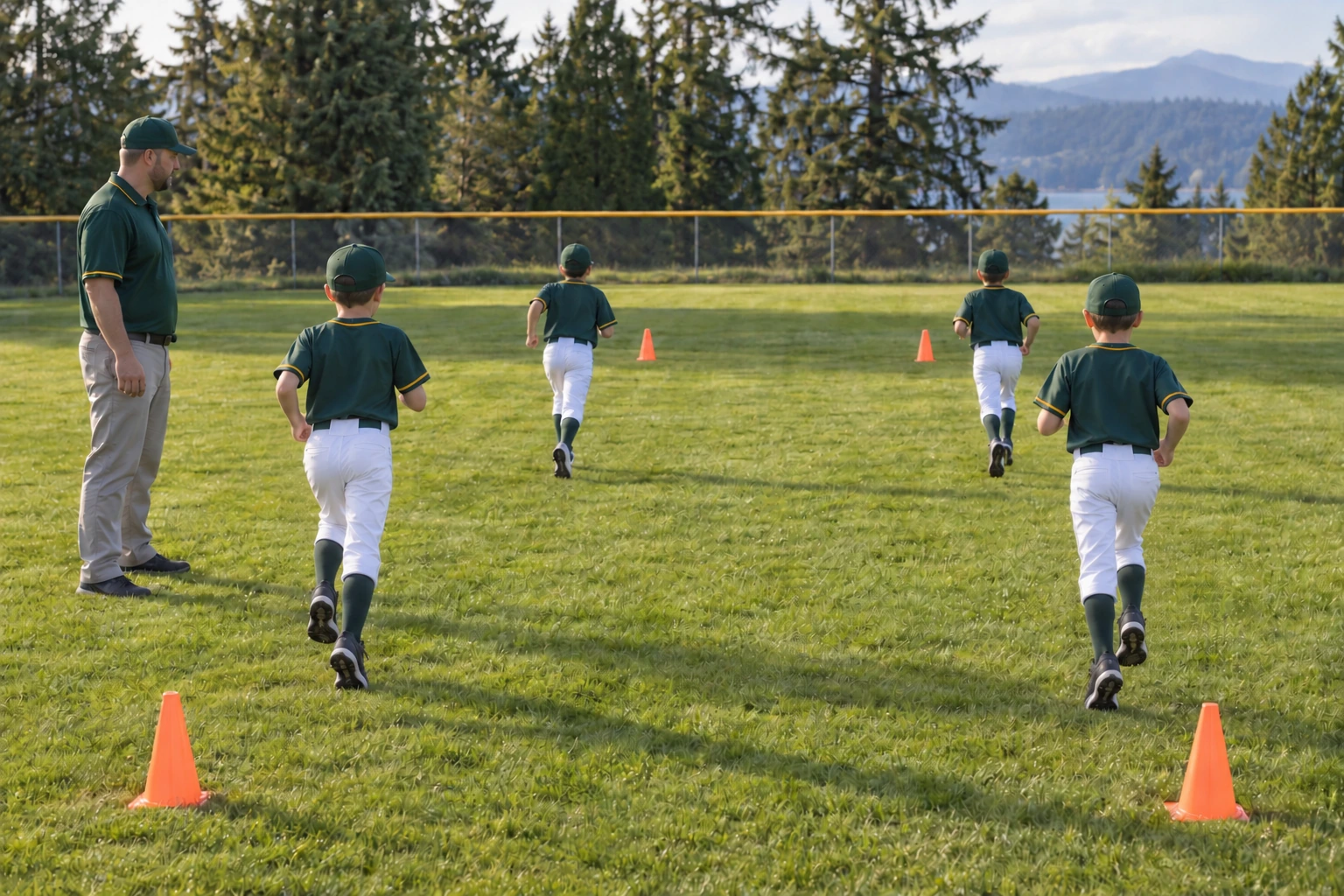
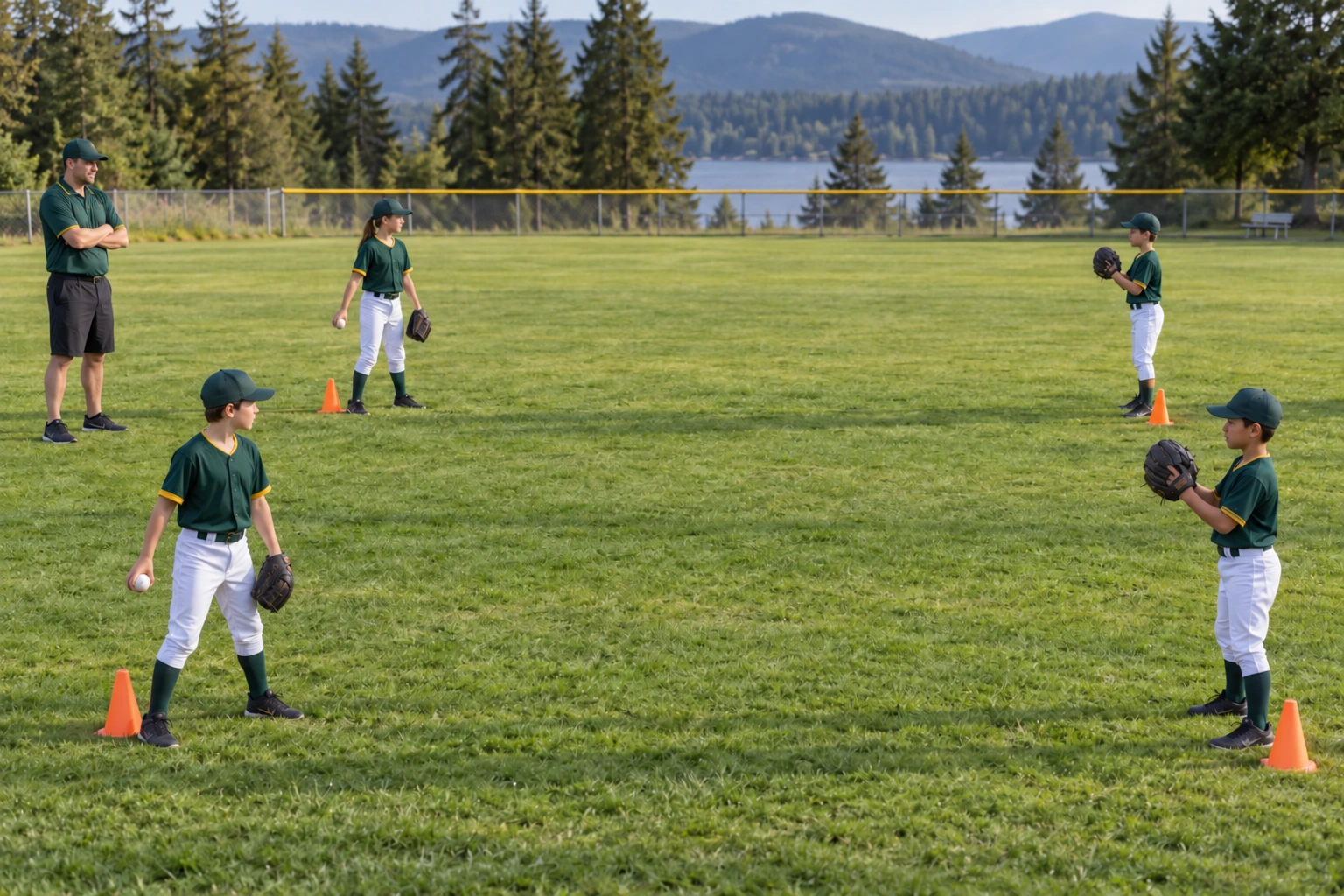
Two spaced warm-up lanes marked by four cones, with all players doing the same easy jog in the same direction and an adult beside the lanes.
Easy-jog phase of the warm-up: spread players out between the cones and keep each trip in one direction. Finish the movement sequence in the steps before throwing. Generated setup illustration; check your field and equipment. Open image for a larger view.

Steps:

  1. Easy jog down and back.
  2. Walking knee hugs and lunges down; jog back.
  3. Side shuffles both directions; carioca if the group is ready.
  4. Arm circles small to big, forward and back.
  5. Two short build-up sprints at about three-quarter speed.

Coaching cues: Tall body, quiet feet. Smooth before fast.

Safety: No throwing until the warm-up is finished. Players with pain sit out and tell an adult.

Easier: Walk the movements and cut the sprints. Harder: Add a reaction start: players sprint on a clap from a ready stance.

Limited space or staff: Indoors: march, knee lifts, gentle in-place side steps and arm circles. No running lanes, sprints or moving lunges; leave room for full arm reach and use a dry, clear floor.

For this division: Keep each movement short and demonstrate it first; use animal names for the walks if it helps.

Partner throwing progression

Throwing and catching · About 10 minutes · 2-30 players per group · 1 approved adult · Space: Half field or infield

Goal: Warm the arm gradually and throw to a target with a repeatable motion.

Setup: Partners on two parallel lines, every throw going the same direction. Leave a wide gap between pairs.

Equipment: 1 ball per pair, cones or chalk for the two lines

Two separated pairs face their partners across marked throwing lanes, holding one ball per pair before an easy throw.
Start with easy, accurate throws to a ready partner. Keep pairs in separate lanes; step back only while throws remain relaxed, then finish closer in. Generated setup illustration; check your field and equipment. Open image for a larger view.

Steps:

  1. Start close with short, easy throws aimed at the partner's chest.
  2. After several easy throws, take a step back and repeat.
  3. Keep backing up only while throws stay accurate and relaxed.
  4. Finish by stepping back in for a few quick, accurate throws.

Coaching cues: Point the glove at the target, then throw. Step toward your partner.

Safety: Everyone throws in the same direction, and nobody walks between lines. Any arm pain stops throwing for that player that day and an adult is told. This is a warm-up, not a distance contest.

Easier: Stay at the first distance and use a softer ball for new catchers. Harder: Add a quick catch-and-release for the last few throws, still at an easy effort.

Limited space or staff: Short of space or adults: one line of pairs along a fence, with one adult watching the whole line.

For this division: Keep partners close (roughly base-path length or less); use softer balls for players still learning to catch.

Catch and funnel

Throwing and catching · About 8 minutes · 2-10 players per group · 1 approved adult · Space: Small safe space (no field)

Goal: Catch with two hands and bring the ball to the throwing hand quickly.

Setup: Partners about two steps apart on their knees, then standing; an adult watches the group.

Equipment: 1 soft ball per pair

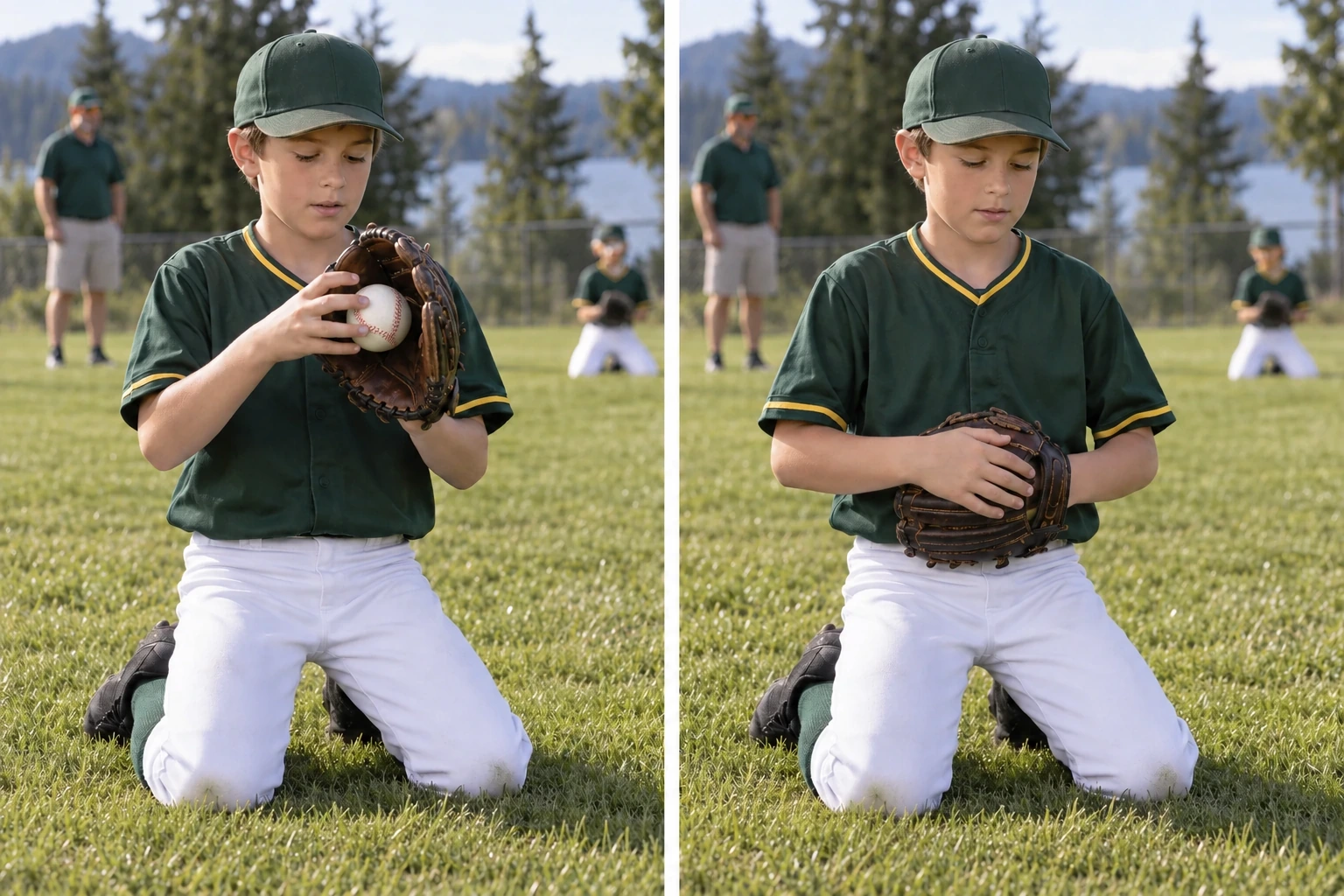
Two views of a kneeling player: receive a white red-seamed soft practice baseball in the left glove, then bring the glove toward the belly with the throwing hand nearby.
Left: receive a soft practice baseball toss with the throwing hand nearby. Right: secure the ball and bring it toward the belly before tossing back. Keep pairs well separated. Generated setup illustration; check your field and equipment. Open image for a larger view.

Steps:

  1. Partner tosses underhand to the chest.
  2. Catch with the glove open to the ball and the throwing hand close by.
  3. Pull the ball to the belly button, then toss back.
  4. Move tosses to the glove side and throwing side.

Coaching cue: Two hands, then belly button.

Safety: Soft balls for anyone still learning to catch. Keep pairs far enough apart that a miss cannot hit another group.

Easier: Roll the ball instead of tossing it. Harder: Add a short step and a throw to a target after each catch.

Limited space or staff: Indoors: rehearse an imaginary catch and funnel with empty hands or a glove, no ball or throw. Foam underhand partner tosses are optional only with division approval, clear separated lanes and adult supervision; never substitute hard balls or throw against a wall.

For this division: Start on the knees; celebrate clean two-hand catches.

Tee hitting into a net

Hitting and decisions · About 6 minutes · 2-4 players per group · 1 approved adult · Space: Small safe space (no field)

Goal: Repeat a balanced swing that finishes through the ball.

Setup: One tee and a net or fence. One batter swings; everyone else waits behind a marked line well outside the swing area.

Equipment: 1 tee per station, hitting net or safe fence, bucket of balls, batting helmets

One helmeted batter at a tee and hitting net, with an adult and waiting players behind the swing area.
One batter holds a bat. Keep the waiting line outside the swing area; stop before loading or collecting. Generated setup illustration; check your field and equipment. Open image for a larger view.

Steps:

  1. Batter sets up the right distance from the tee: bat can reach the ball with a slightly bent arm.
  2. Five swings, then the next player.
  3. Waiting players take turns loading balls only when the adult says the batter is set down.
  4. Rotate: batter, loader, waiting line.

Coaching cues: See the ball on the tee, then swing through it. Finish balanced.

Safety: Only the batter holds a bat. Waiting players stand behind the line. Collect balls only on the adult's call.

Easier: Bigger ball or a lighter bat; fewer swings per turn. Harder: Move the tee for inside and outside pitch locations.

Limited space or staff: No net: hit Wiffle-balls into a fence. Indoors: dry swings with a mirror or partner check.

For this division: Three to five swings per turn keeps the line moving; one cue at a time.

Front toss behind a screen

Hitting and decisions · About 6 minutes · 2-4 players per group · 1 approved adult · Space: Half field or infield

Goal: Time a moving ball and hit it back through the middle.

Setup: An approved adult stands behind the tall panel of an appropriate L-screen, with head and torso protected. Toss underhand through the open area above the low panel toward a helmeted batter, into a net or clear open field.

Equipment: appropriate protective L-screen, bucket of baseballs, net or clear open field, batting helmets

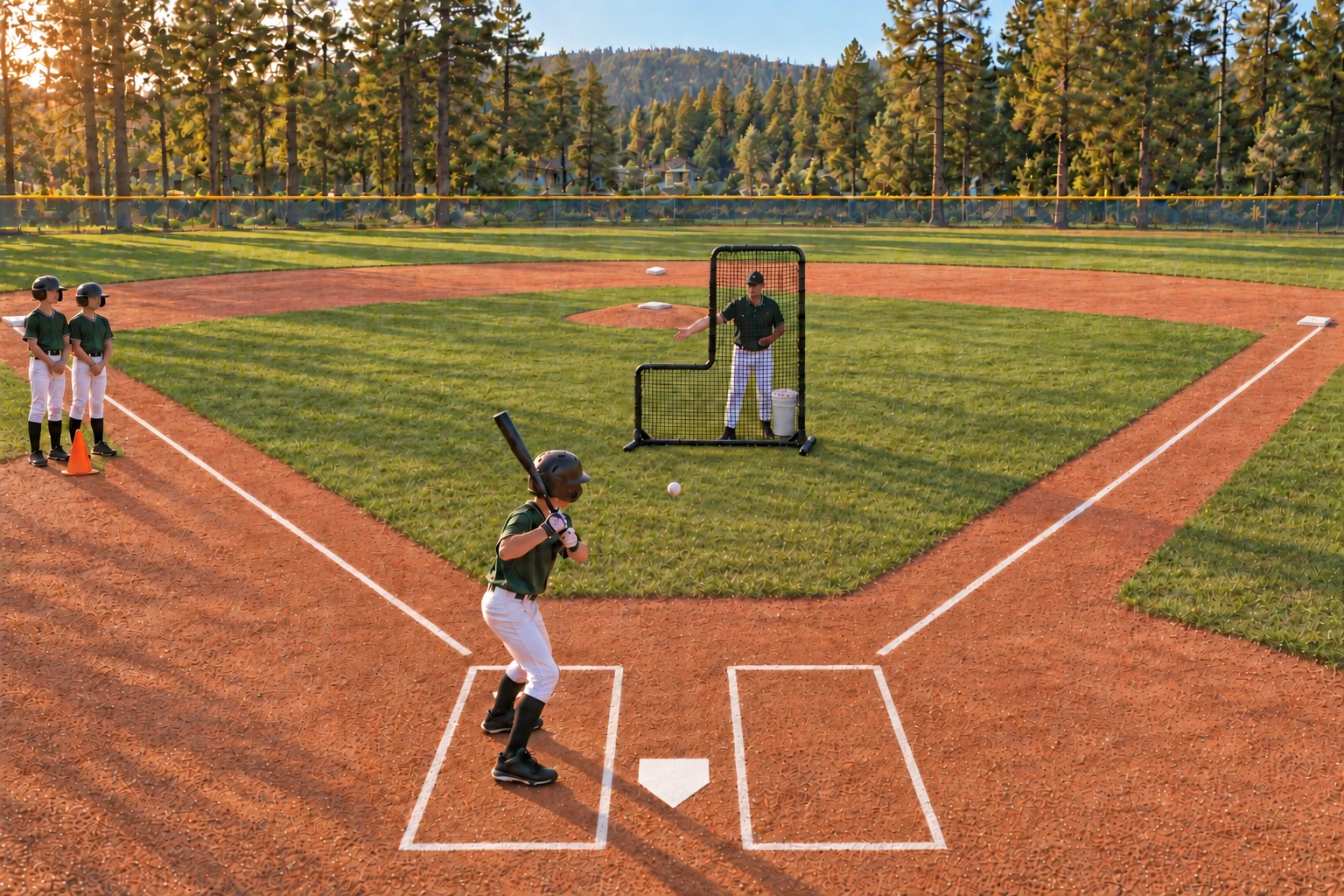
A right-handed screened front-toss scene on a coherent baseball diamond. The flat pentagonal plate sits between batter boxes, foul lines follow dirt basepaths, and the distant mound is separated from the screen. One airborne ball travels from the open screen notch toward home.
Screened front toss in front of the mound: align the tossing hand toward home plate. Protect the head and torso behind the tall panel and use the open area above the low panel, never the mesh. Keep the bucket behind the screen. One airborne ball is shown; both foul lines follow dirt basepaths. Stop before collecting balls. Generated setup illustration; check your field and equipment. Open image for a larger view.

Steps:

  1. Adult shows the ball, then tosses firmly and underhand.
  2. Batter hits the ball back up the middle.
  3. Five swings per turn, then rotate.
  4. Adult stops tossing while balls are being collected.

Coaching cue: Hit it back where it came from.

Safety: Only an approved adult tosses. Position the screen to protect the head and torso; inspect it before use. One batter holds a bat; waiting players stay behind marked cones outside the swing and batted-ball areas. Stop all tosses and put the bat down before collecting balls. No player stands in front of the net or in the batted-ball area.

Easier: Slow the toss and use a larger or lighter ball. Harder: Mix locations; ask the batter to take tosses that are not strikes.

Limited space or staff: No screen: choose Wiffle-ball front toss and use only its specified light balls, or switch to tee hitting. Never use baseballs for the no-screen variation.

For this division: Keep tosses soft and predictable.

Wiffle-ball front toss

Hitting and decisions · About 6 minutes · 2-4 players per group · 1 approved adult · Space: Half field or infield

Goal: Time an easy underhand toss and make controlled contact with a Wiffle-ball.

Setup: An approved adult kneels beyond the batter's full bat reach, facing one helmeted batter. Use Wiffle-balls only, with no screen. Mark a waiting area behind and away from the swing and batted-ball path; keep the hitting area clear.

Equipment: Wiffle-balls, bat, batting helmets, waiting-area cones, clear open hitting area

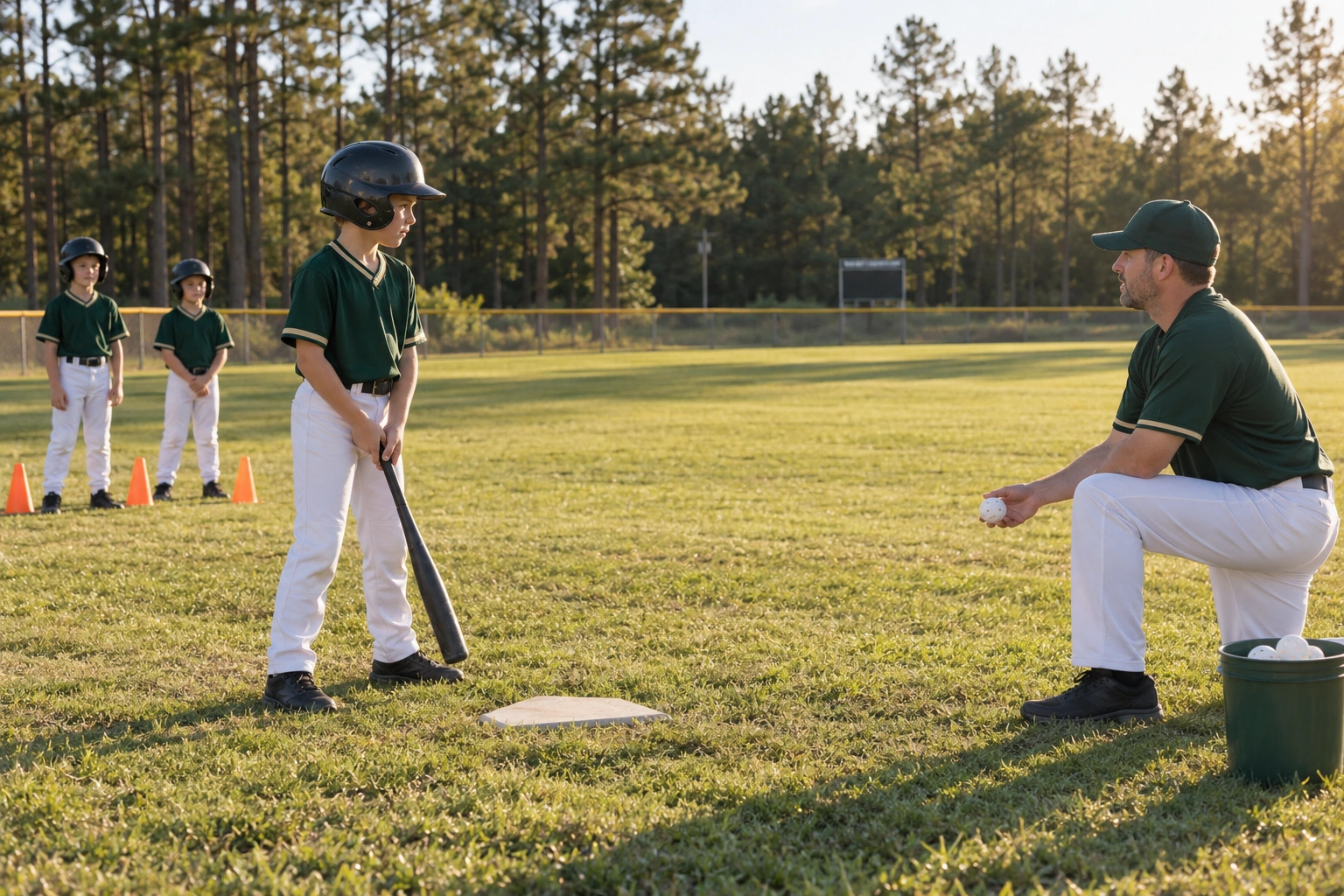
An adult kneels beyond bat reach holding a Wiffle-ball, facing a helmeted batter with the bat down. Helmeted waiting players are behind cones; there is no screen.
Wiffle-balls only. Keep the adult beyond bat reach and waiting players outside swing and batted-ball areas; stop before collecting. Generated setup illustration; check your field and equipment. Open image for a larger view.

Steps:

  1. Adult shows the Wiffle-ball and makes a gentle underhand toss.
  2. Batter makes controlled contact into the clear hitting area.
  3. Five swings per turn; the adult stops tossing before the next player comes in.
  4. Put the bat down before anyone collects balls.

Coaching cues: Easy toss, balanced swing. Wait behind the cones until the adult calls you.

Safety: Wiffle-balls only: do not substitute baseballs or softballs in this no-screen drill. Helmets stay on; only one player holds a bat. The adult stays beyond full bat reach. Keep all waiting players outside swing and batted-ball areas. Wiffle-balls still require spacing and supervision. Stop all swings and tosses before collecting.

Easier: Use slow, predictable tosses and fewer swings. Harder: Vary easy toss locations and ask the batter to take balls outside the target area.

Limited space or staff: If Wiffle-balls or a clear hitting area are unavailable, use tee hitting with its required equipment.

For this division: Demonstrate the waiting area and the stop signal before any swings. Wiffle-ball hitting is a practice-only drill for every division. Use Wiffle-balls only in this no-screen drill; never substitute baseballs or softballs. This drill does not change league game-ball rules.

Count and swing decisions

Hitting and decisions · About 6 minutes · 2-6 players per group · 1 approved adult · Space: Small safe space (no field)

Goal: Practice plate decisions: what to swing at with no strikes and with two strikes.

Setup: Players in a semicircle with bats set down. The adult holds cards or calls out pitch locations and a count.

Equipment: location cards or a drawn strike zone

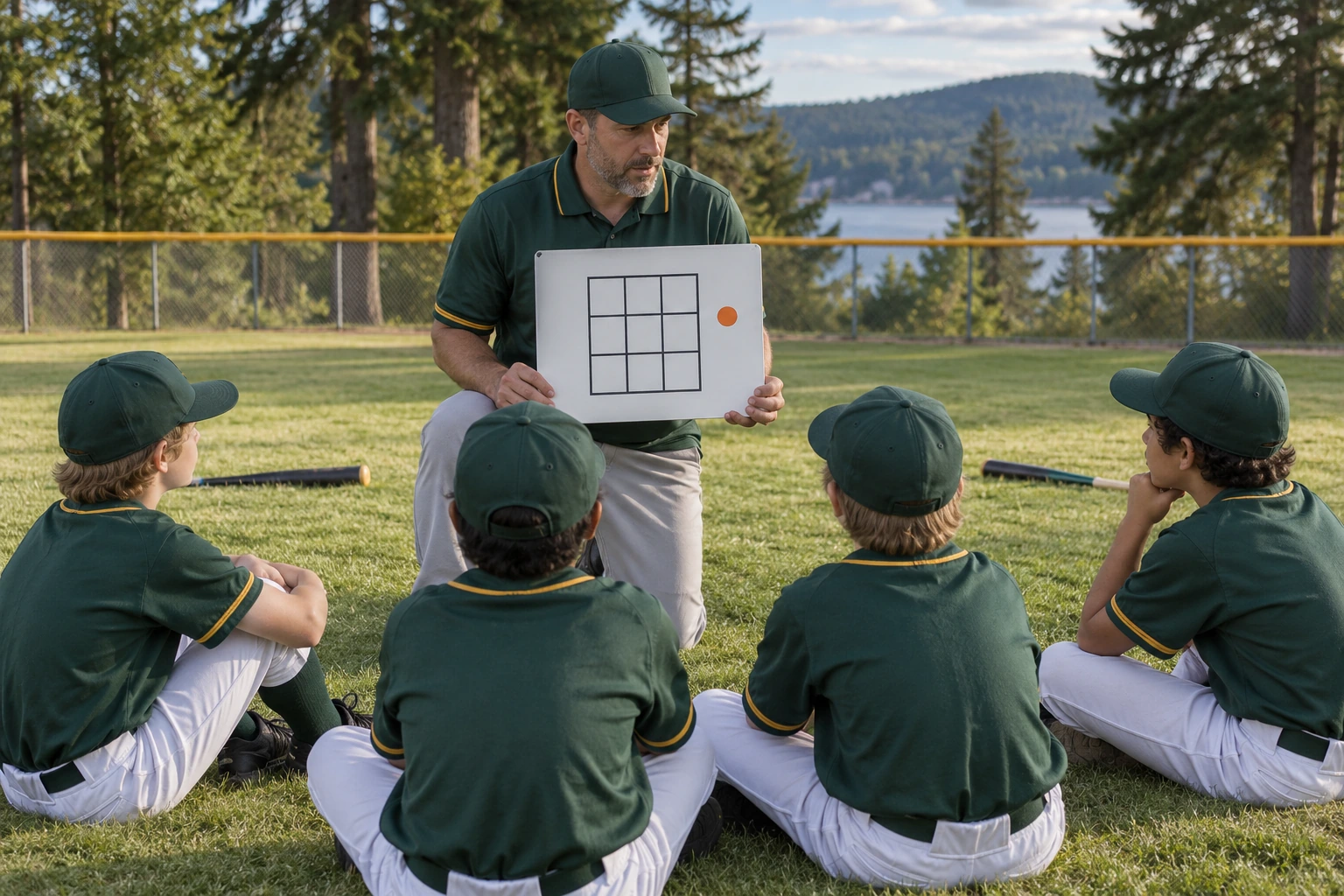
A coach shows a pitch-location grid to seated players; bats are set down behind the group.
Example discussion: call a 1–0 count and show a pitch outside the strike zone; ask each player to choose swing or take and explain why. Repeat with two strikes. Bats stay down; no balls are thrown. Generated setup illustration; check your field and equipment. Open image for a larger view.

Steps:

  1. Adult calls the count, for example "1 and 0".
  2. Adult shows a pitch location.
  3. Each player says "swing" or "take" and why.
  4. Repeat with two strikes and talk about protecting the plate.

Coaching cues: Early in the count, hunt your pitch. Two strikes: protect the plate.

Safety: No bats in hands during the talk. This station needs no thrown or batted balls.

Easier: Only three locations: middle, too high, too low. Harder: Add a game situation: runner on third with one out.

Limited space or staff: Indoors or in the dugout: call counts and pitch locations; players answer swing or take verbally. Keep bats set down and use no thrown or batted balls.

For this division: Keep to strike or not a strike.

Ground balls: ready, field, throw

Infield · About 7 minutes · 3-6 players per group · 1 approved adult · Space: Half field or infield

Goal: Field a ground ball in front and make a controlled throw to a target.

Setup: An adult rolls or hits ground balls from a safe distance. One fielder at a time; a receiver at a base or a net as the target.

Equipment: bucket of balls, base or target net, gloves

An adult, an active fielder and a receiving player arranged for one ground ball, with waiting players to the side.
Feed → field → throw to the receiver. Waiting players and rotation stay outside the active lane; rotate after the ball is dead. Generated setup illustration; check your field and equipment. Open image for a larger view.

Steps:

  1. Fielder starts in a ready stance.
  2. Adult rolls or hits a ground ball.
  3. Fielder moves to the ball, fields it out in front and steps to throw.
  4. Throw to the receiver; rotate fielder to receiver to line.

Coaching cues: Glove down early. Feet to the target, then throw.

Safety: One ball in play at a time. The waiting line stands to the side, out of the throwing lane.

Easier: Roll slowly straight at the fielder. Harder: Add balls to the backhand and forehand sides.

Limited space or staff: Small space: short rolls and underhand tosses to a partner instead of a base throw.

For this division: Rolls only; soft balls for new fielders.

Force out: feed and cover

Infield · About 7 minutes · 4-8 players per group · 1 approved adult · Space: Half field or infield

Goal: Know which base has the force and make a firm, catchable feed to the player covering it.

Setup: Infielders at their positions with one base marked as the force. An adult calls the situation and rolls the ball.

Equipment: bases, bucket of balls, gloves

At close distance, a shortstop makes a right-handed underhand flip to a second baseman with a foot touching second base. Both have left-hand gloves; no runner is in the feed lane.
Example: runner on first, one out; the force is at second. Rehearse the shortstop’s short underhand flip and the second baseman’s cover without a runner until the feeds are controlled. Generated setup illustration; check your field and equipment. Open image for a larger view.

Steps:

  1. Adult calls the runners and outs.
  2. Players say where the play is before the ball moves.
  3. Adult rolls a ground ball; the fielder feeds the covering player.
  4. The cover player catches with a foot on the base.

Coaching cues: Know the play before the pitch. Feed to the chest.

Safety: Covering players stay on their side of the base; no runner is used until the feeds are safe and controlled.

Easier: Walk through with no ball, then use rolls. Harder: Add a runner who starts on the adult's signal.

Limited space or staff: Short on space: a single base and two players at a time.

For this division: Only one force base at a time.

Fly balls: call it and back up

Outfield and relays · About 7 minutes · 3-6 players per group · 1 approved adult · Space: Full field

Goal: Call the ball early, give way by priority, and back up the catch.

Setup: Two or three players in a line of positions. An adult throws or hits high balls between them from a safe distance.

Equipment: tennis or soft balls for younger players, baseballs for older players, gloves

One player calls for a white red-seamed soft practice baseball while a second player yields and stays clear to back up the catch.
Name the positions and priority before each rep. One player calls for the ball; the other answers, gives way and backs up. Start with soft practice baseballs and stop if two players converge. Generated setup illustration; check your field and equipment. Open image for a larger view.

Steps:

  1. Adult names the positions and their priority.
  2. Adult throws a ball between two players.
  3. The player with priority calls loudly; the other answers and moves to back up.
  4. Rotate positions after each catch.

Coaching cues: Call it loud and early. The other player backs up.

Safety: Start with soft balls. Players never run full speed toward each other without a call; the adult stops the rep if two players converge.

Easier: Short, softly thrown balls with one player at a time. Harder: Add the sun, a wind side or a third fielder.

Limited space or staff: Limited space: short pop-ups with tennis balls in a small area, two players at a time.

For this division: Tennis balls and short throws; practice the words first.

Relay lines

Outfield and relays · About 7 minutes · 3-6 players per group · 1 approved adult · Space: Full field

Goal: Move the ball quickly and accurately through a relay player.

Setup: Lines of three players spread along a straight lane: outfielder, relay, receiver at a base. Lanes far apart.

Equipment: 1 ball per lane, cones for lanes

Two separated parallel lanes of players, each with a receiver and a marked base.
Outfielder → relay → receiver. Keep lanes separate and stop throws before players change positions. Generated setup illustration; check your field and equipment. Open image for a larger view.

Steps:

  1. Outfielder throws to the relay player's glove side.
  2. Relay turns to the glove side and throws to the receiver.
  3. Receiver catches and tags the base.
  4. Rotate positions every few throws.

Coaching cues: Relay: hands up, turn glove side. Hit the chest.

Safety: Lanes run parallel with nobody crossing them. Short distances first; stop for arm pain.

Easier: Shorten the lane and roll the ball in. Harder: Add a timer target the group tries to beat with accurate throws.

Limited space or staff: Tight space: shorter lanes with underhand tosses.

For this division: Two-player lanes and short throws.

Home to first: run through the base

Baserunning · About 6 minutes · 3-14 players per group · 1 approved adult · Space: Half field or infield

Goal: Run hard from the batter's box through first base and look for the ball.

Setup: Home plate and first base. Players take turns from the batter's box after a dry swing.

Equipment: bases, cones

View from behind a flat five-sided home plate toward first base. Batter boxes share the field perspective, and the first-base foul line begins beyond the box. A helmeted runner moving away from home touches first, whose outside edge follows the foul line; waiting players and the coach stay clear.
Shown: touch first while running away from home. Keep running through the bag, then slow down beyond it and return outside the running lane. One runner at a time. Generated setup illustration; check your field and equipment. Open image for a larger view.

Steps:

  1. Dry swing, drop the bat safely (no throwing it).
  2. Run hard, touch the front of the base and run through.
  3. Break down after the base and look toward the infield and the coach.
  4. Walk back along the outside of the line.

Coaching cues: Run through, not to, the base. Look for the coach.

Safety: One runner at a time. Runners return outside the base line. Helmets on for running if your rules require it.

Easier: Start from a standing position without a swing. Harder: The adult calls "round it" or "stay" as the runner approaches.

Limited space or staff: No field: straight-line sprints to a cone, practicing the run-through and look.

For this division: Focus on dropping the bat safely and running through.

Leaving the base on time

Baserunning · About 6 minutes · 3-10 players per group · 1 approved adult · Space: Half field or infield

Goal: Leave the base at the moment this division allows, then read the ball.

Setup: Runners at first base. An adult acts as the pitcher and a second player as the batter with no bat.

Equipment: bases

A helmeted runner waits with a foot on first while watching a coach prepare a simulated pitch. Home plate is outside this camera view.
Paused setup before the simulated pitch; this picture does not show when to leave. Read this division’s Base Running lesson, then practice its permitted departure timing. No ball or bat is used. Generated setup illustration; check your field and equipment. Open image for a larger view.

Steps:

  1. Read Lesson 6 (Base Running) for this division's leaving-the-base rule first.
  2. The adult simulates a pitch.
  3. Runners leave only when the division rule allows.
  4. The adult calls "ground ball", "line drive" or "fly ball"; runners react.

Coaching cues: Know when you may leave. Line drive: freeze.

Safety: No thrown ball is needed. Space runners so they do not collide on the base.

Easier: Walk-through with the adult naming each step. Harder: Add the coach's signs from the Team Offense lesson.

Limited space or staff: Any open area with a marked base works.

For this division: One read at a time.

Tag-up reads

Baserunning · About 6 minutes · 3-10 players per group · 2 approved adults · Space: Full field

Goal: Decide when to tag up and when to go halfway on a fly ball.

Setup: Runners at third (or second). An adult throws a fly ball to an outfielder; another adult acts as the base coach.

Equipment: bases, soft balls for younger players

A helmeted runner stands on the homeward side of third with a shoe visibly on top of the bag, watching a deep fly approach an outfielder. The adult base coach stays clear of the route.
Deep-fly example with fewer than two outs: stay in contact with the base while watching the catch. Leave on the catch when the base coach says go; the shallow-fly read is different. Generated setup illustration; check your field and equipment. Open image for a larger view.

Steps:

  1. Runner stands on the base with the outs called.
  2. On a deep fly with fewer than two outs, tag and watch the catch.
  3. Leave on the catch when the base coach says go.
  4. On a shallow fly, go partway and return if it is caught.

Coaching cues: Fewer than two outs: tag on the deep fly. Leave on the catch.

Safety: Runners slide only as taught in the lesson and only where the adult has checked the base area.

Easier: The adult calls "tag" or "halfway" before the throw. Harder: Add a throw home and a decision to stop.

Limited space or staff: Limited space: runners react to called flies with no ball thrown.

For this division: Only the deep-fly tag-up.

Catcher stance, receiving and blocking

Catcher footwork · About 7 minutes · 1-4 players per group · 1 approved adult · Space: Small safe space (no field)

Goal: Hold a balanced stance, catch the ball quietly, and block balls in the dirt.

Setup: Catchers in full gear, spaced apart. An adult tosses soft balls from a short distance.

Equipment: full catcher's gear, soft or foam balls for blocking

A catcher in full gear demonstrates a balanced receiving stance, then a blocking position with both knees down and a white, red-seamed soft practice baseball in front.
Left: balanced stance and a quiet receiving target. Right: knees down, glove low, chest over the soft ball to keep it in front. Full gear for tossed balls; use short sets and soft balls for blocking. Generated setup illustration; check your field and equipment. Open image for a larger view.

Steps:

  1. Stance: feet wide, weight balanced, glove out front.
  2. Adult tosses to the glove; catcher receives quietly.
  3. Adult bounces a soft ball in front; catcher drops to the knees and keeps the ball in front.
  4. Rotate after five reps.

Coaching cues: Quiet glove. Chest over the ball.

Safety: Full gear for any ball thrown at a catcher. Blocking reps use soft balls and short sets.

Easier: Only stance and receiving; no blocking. Harder: Add a transfer and a throwing footwork step (no long throw).

Limited space or staff: Indoors or without gear: stance, imaginary receiving and slow footwork only, no ball, throw or blocking drop. Keep players apart on a dry, clear floor. Full gear is required before any ball is thrown at a catcher.

For this division: Soft balls and very short sets.

Rundown decisions

Team situations · About 7 minutes · 4-8 players per group · 1 approved adult · Space: Half field or infield

Goal: Run the runner back toward the last base with as few throws as possible.

Setup: Two bases, a fielder at each, and a runner between them. Start at walking speed.

Equipment: bases, soft ball for the first reps

A close, ground-level home-to-third walking rehearsal: a helmeted runner walks toward a receiving partner near third, followed by a fielder holding a ball in his right hand and wearing a glove on his left. A coach observes from foul territory.
Home-to-third example, walking rehearsal: guide the runner back toward third, then throw only on the partner’s call. Begin with a soft ball; tags are gentle and below the shoulders. Check base distances for your division. Generated setup illustration; check your field and equipment. Open image for a larger view.

Steps:

  1. Fielder with the ball runs at the runner with the ball held up.
  2. Throw only when the partner calls "now".
  3. Tag the runner with the ball in the glove.
  4. Rotate runner to fielder.

Coaching cues: Ball up, run hard at the runner. Throw on "now".

Safety: Tags are gentle, below the shoulders. Start walking; build speed only when throws are controlled.

Easier: Walk-through with no ball. Harder: Add a second runner and a backup fielder.

Limited space or staff: Small space: shorten the distance between bases.

For this division: Walk-through only, with a soft ball.

Situation scrimmage

Team situations · About 15 minutes · 6-30 players per group · 1 approved adult · Space: Full field

Goal: Everyone makes the right decision for the called situation: where the ball goes and who covers.

Setup: A defense in the field and a group of runners. An adult calls the runners and outs, then hits or rolls the ball.

Equipment: bases, bucket of balls, batting helmets for runners

A wide view of a coherent baseball diamond: a coach at home pauses a runner-on-first situation while the fielders discuss the force play and coverage. First is at full basepath distance, with the mound aligned toward second.
Paused example: runner on first, one out. Name the play and who covers before the coach rolls one ball. Walk through first, then rotate positions after discussing one improvement. Generated setup illustration; check your field and equipment. Open image for a larger view.

Steps:

  1. Adult calls the situation, for example "runner on first, one out".
  2. Every fielder says where the play is.
  3. Adult puts the ball in play; players make the play.
  4. Short talk: what went right, one fix. Rotate positions.

Coaching cues: Know the play before the pitch. Talk to each other.

Safety: One ball in play at a time. Runners wear helmets. The adult hits from a spot where no fielder is in front of a batted ball they cannot see.

Easier: Walk-through first, then rolled balls. Harder: Add the base coaches and a second runner.

Limited space or staff: Short on space or adults: walk-through the same situations with no ball.

For this division: Rolled balls and one runner.

Pitching mechanics without a ball

Throwing and catching · About 6 minutes · 1-6 players per group · 1 approved adult · Space: Small safe space (no field)

Goal: Practice balance and direction toward the target with no throwing load.

Setup: Players on a line facing a target, a towel or no object in hand.

Equipment: small towel per player (optional)

Two views of a right-handed player rehearsing without a ball: balance on the right leg with the left knee raised, then stride toward the target onto the left leg.
Right-handed example, no ball: left frame holds balance on the right leg; right frame strides onto the left leg toward the target and finishes over it. Left-handed players reverse the sides. Move slowly with adult feedback. Generated setup illustration; check your field and equipment. Open image for a larger view.

Steps:

  1. Balance position, hold for a count of two.
  2. Stride toward the target and finish over the front leg.
  3. Repeat slowly; the adult checks direction.
  4. Talk about one change for next time.

Coaching cue: Balance, then go to the target.

Safety: No ball is thrown, so no pitch count starts. Live pitching practice needs an adult tracking throws and the player's recent game pitches; game limits are not practice targets.

Easier: Balance only. Harder: Add the arm path slowly with the towel.

Limited space or staff: Indoors: balance and step slowly with empty hands, no ball or towel. Keep enough space for full arm reach, use a dry, clear floor and stop for pain.

For this division: Balance and step only.

Closing huddle

Team situations · About 5 minutes · 1-30 players per group · 1 approved adult · Space: Small safe space (no field)

Goal: Name one thing each player improved and one thing to practice at home.

Setup: Players seated in a circle with water.

Five players and their coach sit in a circle with water bottles for a closing discussion. Gloves, helmets and one closed equipment bag are set aside; no loose bats or poles are present.
One win and one next step: let each player name an improvement, then agree on the team’s next goal. Remind players to report pain or injury and confirm approved pickup before dismissing them. Generated setup illustration; check your field and equipment. Open image for a larger view.

Steps:

  1. Each player names one thing that went well.
  2. Coach names one team goal for next time.
  3. Remind players to tell an adult about any pain or injury.
  4. Collect equipment together.

Coaching cue: One win, one next step.

Safety: Confirm every player is picked up by an approved adult per league policy.

Easier: Coach asks yes-or-no questions. Harder: Players ask each other the question.

Limited space or staff: Indoors: sit or stand in a clear circle, share one win and one next step, and confirm approved pickup. Keep bats and balls set down.

For this division: Keep it short and positive.

Complete Rules and sources

Pitching and rest

Limits, recovery and pitcher eligibility.

Lineups and participation

Roster placement, batting order and defensive rotation.

Game and event rules

Check which rules govern your game.

Field dimensions

The field profile and its governing source.

Safety at practice

Weather, head injuries, throwing and supervision.

Coaching practice

Before practice: the site and the plan

  • Know the field address and where an ambulance would enter. Carry a charged phone.
  • Bring a first-aid kit and know where the nearest AED is, if the site has one.
  • Decide who calls 911 and who meets responders before anyone gets hurt.
  • Keep emergency contacts where your league keeps them. This planner has no place for names, medical details or phone numbers, and none should be typed into it.

Safety guidance

Weather and heat

  • Thunder or lightning: stop, and move everyone into a substantial building or a hard-topped vehicle with the windows closed. A dugout is not shelter.
  • Wait at least 30 minutes after the last thunder before going back out (National Weather Service guidance), and follow your site plan.
  • Heat: plan water breaks and shade. Stop a player who looks dizzy, confused or unusually tired and get help.

California law and CDC guidance

Head injury, fainting and emergencies

  • California Health and Safety Code 124235 applies to youth sports organizations in California: a player suspected of a concussion or other head injury, or who passes out or faints, is removed from the activity for the rest of the day.
  • That player does not return until a licensed healthcare provider gives written clearance. After a concussion or head injury, return follows a graduated protocol of at least seven days under that provider. The coach never clears a player.
  • For a suspected head injury the organization notifies a parent or guardian of the time, the symptoms seen and any treatment given.
  • Call 911 for anyone who is unresponsive, not breathing normally, or having a seizure. Start CPR and use an AED if trained and one is available.
  • Coaching advice: stop activity for chest pain, unusual shortness of breath or a racing heartbeat during exercise, and tell the parent or guardian.

Coaching practice

Arms and throwing

  • Any arm pain stops throwing for that player that day. Tell a parent or guardian.
  • Game pitch limits are maximums for games, not targets for practice. A practice plan never counts as pitching eligibility.
  • Breaks between throwing blocks are part of the plan. Do not shorten warm-up or throw more to fill time.

Coaching practice

Lanes, bats and loose balls

  • Every throwing line throws the same direction; nobody walks between lines.
  • Only the batter holds a bat. Waiting players stand behind a marked line.
  • Balls are collected on an adult's call, never while someone is swinging or throwing. Players do not chase balls into another station.
  • Helmets for batters and runners, and any other equipment your rules require.

League policy

Adults at practice

  • Drill adult counts are station minimums. Follow the organization's supervision, screening and reporting policies. California youth-service policy requires at least two mandated reporters to be present to the greatest extent possible when adults contact or supervise children (BPC 18975).
  • Only league-approved adults who have completed the required screening and training lead stations.
  • Keep adult-player interactions observable and interruptible: no one-on-one time out of sight.
  • If there are not enough approved adults for every station, run fewer stations. Never leave a station with bats or thrown balls unsupervised to make the numbers work.

Coaching situations

Practical examples for planning and managing the game.

Build a player-first practice

Choose one game problem, demonstrate a short solution, let players make a decision, then use coaching points to improve the next rep.

  • Coaching point: Keep stations small enough for every player to act and explain a read.
  • Avoid: A busy schedule is not proof that players practiced the intended skill.
  • Also consider: Adjust station length to attention and league-approved staffing. Keep adult-player interactions observable and interruptible.

Coaching tip

Plan participation with the right authority

PONY 9(J) recommends at least two innings for each Mustang player. The adult also checks the league's actual adopted policy.

  • Coaching point: Keep an inclusive participation plan and label national text, adopted local policy and team coaching choices separately.
  • Avoid: Recommendations do not become mandatory penalties because they are sensible.
  • Also consider: Verify the batting-order format and any written local minimum before managing a game.

Related rule or safety source: Player participation

Return a starter correctly

A starter was removed for a substitute. The coach reviews PONY 9(L), not Little League 3.03. Under PONY 9(L), a removed starter may re-enter one time, back in the same spot in the batting order. Only the 9(M) emergency exception can place a returning player in a different spot.

  • Coaching point: Keep lineup re-entry separate from pitcher eligibility. PONY 9(M) also has a specific emergency exception.
  • Avoid: Do not categorically erase the otherwise-eligible last-removed-player exception for illness, injury or ejection with no eligible substitute.
  • Also consider: Use the exact emergency procedure and original substitution record rather than inventing an available player.

Related rule or safety source: Substitution Pitching limits

Do not return a withdrawn pitcher

A Mustang 10U pitcher leaves the mound and stays in the game at another defensive position.

  • Coaching point: Keep a clear pitching record. Moving to another position does not create a same-game return right.
  • Avoid: Intermediate's pitcher-return allowance must not leak into this PONY rule.
  • Also consider: A later game needs its own daily-count, rest and readiness checks; this answer is about the same game.

Related rule or safety source: Pitching limits Safety

Apply the younger player's pitch band

A league-age 8 player and a league-age 10 player are both eligible for this national Mustang U-age program. PONY 10(D) sets the daily pitch maximum by league age: 50 pitches for ages 7-8 and 75 for ages 9-10.

  • Coaching point: Use the individual's verified league age; the division title is not a single pitch-count band.
  • Avoid: Do not overlook younger eligible players in the national U-age structure.
  • Also consider: A league may use the two-year program; verify roster eligibility separately from the pitching table.

Related rule or safety source: Eligibility Pitching limits

Keep regular season and tournament distinct

The team is preparing for a different competition. The adult checks the event book before carrying over a regular-season routine.

  • Coaching point: Mustang tournament leads use the unrestricted option even when a regular-season league chose another option.
  • Avoid: A familiar team routine is not evidence of tournament eligibility.
  • Also consider: This curriculum covers a national regular-season training profile, not a particular event policy.

Related rule or safety source: Leaving a base Substitution Player participation

Sources and review date

Sources reviewed 2026-09-06. Check the current official rules and written local options for your game. Coaching suggestions are teaching choices.