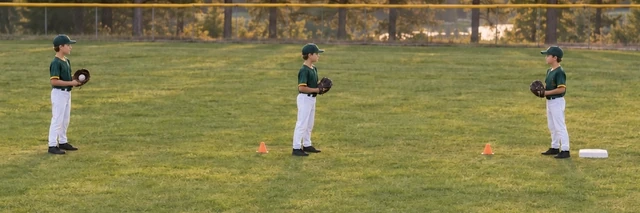
Read these ideas, then try the situations below. Practice with a coach when a movement is new.
Quiz Mode: try each answer before checking the explanation.
Coach View: use the answers and teaching notes to guide practice.
Give priority a voice
Agree on a team priority before a ball drops between fielders. In this practice plan, the center fielder takes a reachable ball from a corner outfielder, and an outfielder coming in takes a reachable ball from an infielder going back. The fielder who can make the safest play calls loudly and early; the yielding player backs up. A call never makes a collision safe.
Build a relay line
The cutoff player gets between the outfielder and the intended base, gives the outfielder a visible target, and turns feet toward the next throw. The throw should reach a teammate, not just travel as far as possible.
See example: Relay and backup lanes
OutfielderFind a reachable target
Cutoff / relayLine up · secure · turn
Receiving fielderCall the play · secure the throw
BackupBeyond the receiving target
Role diagram only: outfielder → cutoff → receiving fielder, with a backup beyond the receiving target. Read this lesson’s actual situation for the destination, named positions and extra coverage. This diagram does not assign a base or show field distances.
Use one clear decision
A coach or designated fielder calls whether to cut the throw or let it pass. The receiver catches first, checks the runner and then throws if a play remains.
Cover the miss and reset
A backup player moves behind the receiving base. After the immediate play, return the ball under control and confirm where every runner stopped.
Practice it here
Place a cutoff between the outfielder and a 60-foot base. Walk the ball through outfielder, cutoff and covered base; let the backup find a position behind the receiver.
Situation 01
Call the ball early
Two defenders approach a fly. The team's rehearsed priority call identifies the player who will catch it; the other changes to backup.
Where everyone plays: SLVLL AA
Bases 60 ft apart · player-pitching distance 46 ft · schematic, not to scale. Rule source
1 Pitcher
2 Catcher
3 First base
4 Second base
5 Third base
6 Shortstop
7 Left field
8 Center field
9 Right field
Coach answer: Communicate and move to a useful backup position The player who yields the catch can still help by calling the play and moving behind the likely miss.
Coaching Points
Rehearse the team's actual priority language before live repetitions.
Common Mistakes
A loud call without a shared meaning is still ambiguous.
Alternative Considerations
Wind, sun and player position can change who has the best play.
Coaching tip
Situation 02
Give the outfielder a target
A ball reaches the gap. The cutoff player moves into line between the outfielder and the called destination, presenting a visible target.
Coach answer: Create a clear, reachable target on the intended line A clear cutoff target on the intended line gives the outfielder a reachable throw and the defense a next play.
Coaching Points
Have the destination fielder help align the cutoff with a short voice cue.
Common Mistakes
A strong throw can still fail when nobody knows its destination.
Alternative Considerations
The relay may need an extra player for the distance and arm strength available.
Coaching tip
Situation 03
Use a clear relay decision
On an AA batted-ball play, the outfielder has a reachable cutoff and a covered base.
Coach answer: Name the reachable target before the ball reaches the cutoff Name one reachable target before the throw reaches the cutoff. Do not throw again after the umpire stops play.
Coaching Points
Name the destination early and choose a calm hold when there is no useful play.
Common Mistakes
More throws do not automatically mean better defense.
Alternative Considerations
Teach the throw sequence slowly before adding runners.
Coaching tip
Situation 04
Receive ready to throw
In a dry AA relay drill, an infielder receives a throw from the outfield and practices a balanced catch and transfer. AA typically stops when the pitcher has the ball; follow the umpire's actual stop and runner directions in a game.
Coach answer: Secure the ball and move into a balanced throw Catch first, then turn feet toward the next target. Throwing before you are balanced makes the relay less accurate.
Coaching Points
Practice secure feet and hands in the drill. In a game, return the ball under control and follow the umpire's actual stoppage and runner directions.
Common Mistakes
Speeding up an unstable transfer repeats the mistake faster.
Alternative Considerations
A different footwork pattern may suit the throw angle; preserve control.
A throw is headed to third. A defender who is not receiving it takes a position to stop an overthrow without entering the runner's way.
Coach answer: Behind the likely throw path with safe spacing A backup belongs behind the likely missed throw, with enough space to react safely.
Coaching Points
Freeze a rehearsal and ask every player to name a backup responsibility.
Common Mistakes
Watching the main play is not a defensive assignment.
Alternative Considerations
Use the fence and available foul ground to choose a practical backup spot.
Coaching tip
Situation 06
Recognize when this play ends
The AA pitcher receives the ball back. The umpire calls Time and directs a runner to return to the previous base. The runner checks the umpire and coach before moving again.
Coach answer: Return to the base the umpire directs The umpire has stopped this play and directed the return. Go back to that base and wait for the next legal play; do not apply an AA stopping convention to another division.
Coaching Points
Call the new outs and base situation after the play.
Common Mistakes
A local stopping rule and a player's guess that action is over are different things.
Alternative Considerations
AA typically stops when the pitcher has the ball. The published ground rules describe infield possession and halfway runner placement; follow the actual umpire instructions.