Read these ideas, then try the situations below. Practice with a coach when a movement is new.
Quiz Mode: try each answer before checking the explanation.
Coach View: use the answers and teaching notes to guide practice.
Decide before the pitch
Count the outs and locate each runner. Say where your first throw would go on a ground ball and who covers that base. On a bobble, look again: the available out may have changed.
Secure and communicate
Move to the ball under control, field it before rushing a throw, and call for a fly ball early. A teammate should know whether to cover a base or back up a throw.
Force or tag?
A force exists because the batter becomes a runner and pushes another runner toward the next base. If an out removes that push, touching the next base alone may no longer retire the runner. In divisions with an infield-fly rule, the called batter is out; runners are no longer forced forward, the ball stays live, and an off-base runner may need a tag.
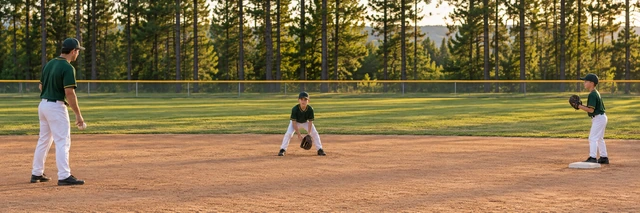
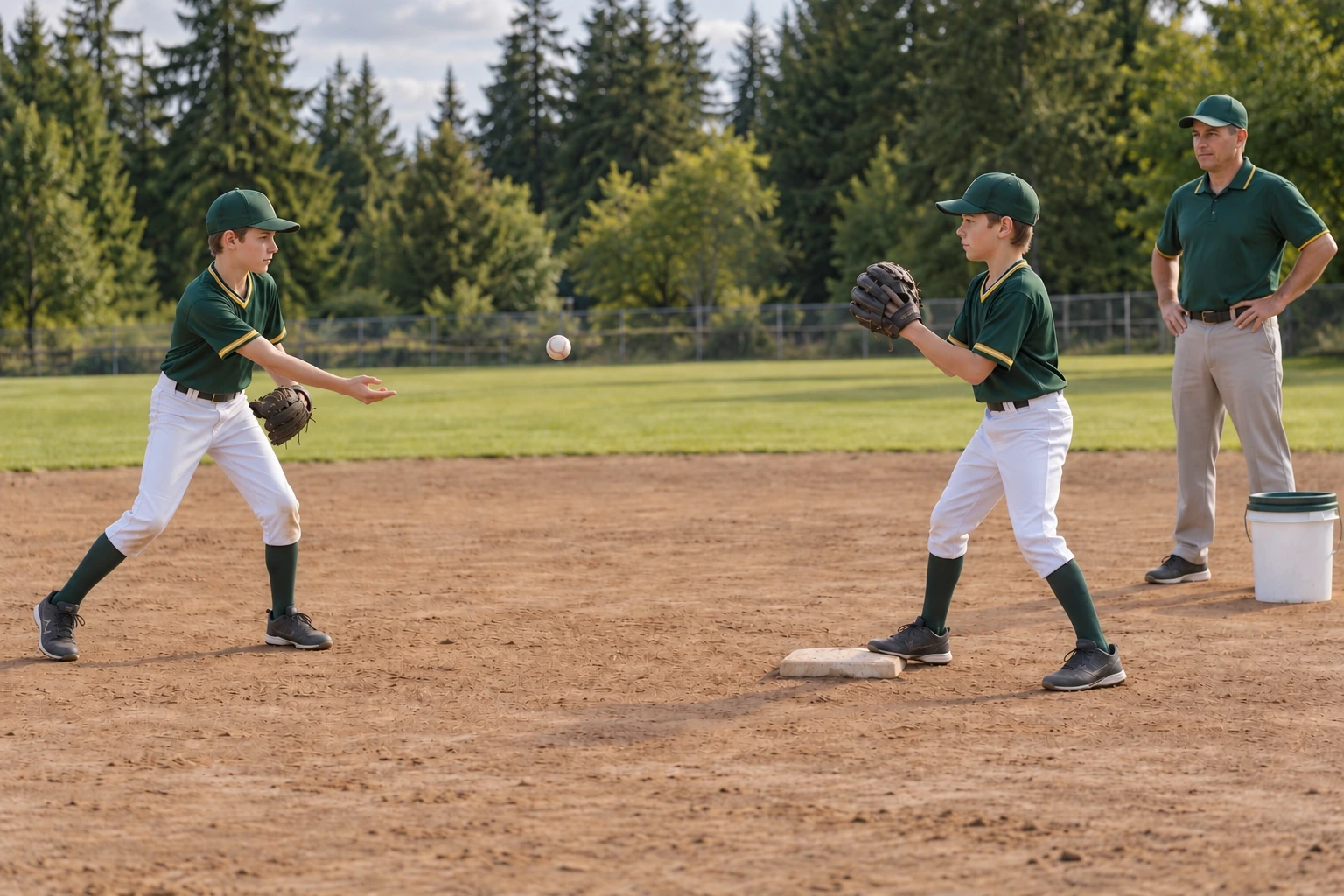
See example: Short feed and coverIllustrative short feed toward second. Call a runner-on-first force situation before the rep; no runner is shown. The receiver covers second while securing the ball. Start the rehearsal without a moving runner. This picture does not show a completed out or a removed force.
AA does not use infield fly
SLVLL AA does not apply the infield-fly batter-out rule. Field a fly ball or a dropped fair ball and check the ordinary forces; do not assume the batter was automatically put out.
Make a backup plan
On a short ground ball, name the charging fielder, the base cover and the backup before the pitch. On any throw, move behind the likely target so a miss does not travel farther.
Practice it here
On the 60-foot diamond, point to the nearest force base before a softly hit ball is rolled. Field first, then throw only after a teammate covers that base.
Situation 01
Know your next play
Before each pitch, the shortstop checks the outs, runners and likely force play, then shares the coverage call with the second baseman.
Where everyone plays: SLVLL AA
Bases 60 ft apart · player-pitching distance 46 ft · schematic, not to scale. Rule source
1 Pitcher
2 Catcher
3 First base
4 Second base
5 Third base
6 Shortstop
7 Left field
8 Center field
9 Right field
Coach answer: Where you will play the ball and who covers the next base A fielder needs both a first play and the teammate covering the target. Otherwise a good throw can find an empty base.
Coaching Points
Ask two adjacent defenders to repeat the same coverage call.
Common Mistakes
Knowing your own job is not enough when the next base is uncovered.
Alternative Considerations
The coach may change alignment by hitter and score; communicate the change.
Coaching tip
Situation 02
Secure the routine out
A ground ball comes with no realistic play on the lead runner. Field under control and choose the available out instead of forcing a late throw.
Coach answer: Take the available out with a controlled throw Secure the ball and take the out that is still available. A late throw at a runner who is already safe adds risk.
Coaching Points
Rehearse the first choice and a fallback when the ball is bobbled.
Common Mistakes
A predetermined throw can survive in a player's mind after the play changes.
Alternative Considerations
Late-game score and outs may justify a different risk; name it before the pitch.
Coaching tip
Situation 03
Separate the force from the fly rule
In AA, first and second are occupied with one out. A fair pop-up drops untouched; no other out has occurred. AA does not use the infield-fly batter-out rule.
Coach answer: The original force remains; a defender may tag the next base AA does not use the infield-fly batter-out rule in this situation, so the original force remains after the dropped ball.
Coaching Points
Secure the ball and identify the actual force or tag play before throwing.
Common Mistakes
AA has no infield-fly batter out.
Alternative Considerations
A caught ball is a different event; walk through it separately.
There is one out with first and second occupied. A fair fly, not a bunt or liner, is within ordinary infield effort. SLVLL AA local instructions leave out the infield-fly rule, so there is no automatic batter out and the ordinary play continues.
Coach answer: AA does not use the infield-fly rule AA does not apply the infield-fly rule. Field the ball and make the ordinary play.
Coaching Points
The catch still matters. Communicate and avoid collisions rather than waiting for an assumed outcome.
Common Mistakes
Ordinary effort is a judgment appropriate to the players, not a painted line.
A softly hit swinging ball rolls in front of the AA infield. This is not a bunt drill.
Coach answer: Name the fielder, covered target and backup One fielder takes the short ball, another covers the target and a third backs up. Everyone charging leaves a base open.
Coaching Points
Walk the jobs first, then add a controlled ball and receiver.
Common Mistakes
A short ball does not require every infielder to chase it.
Alternative Considerations
AA prohibits bunting, but defenders still need a plan for softly hit balls.
The pitcher has the ball on the plate and the catcher is ready. This Minor runner has no legal pre-pitch lead.
Coach answer: The appropriate post-pitch play, with the local runner limits checked There is no pre-pitch lead to defend. After legal departure, cover the base and follow AA's runner limits.
Coaching Points
There is no conventional pre-pitch-lead pickoff situation. That does not mean every later attempt to retire a runner is forbidden.
Common Mistakes
Do not import Intermediate leads or use the no-balk classification as a complete illegal-pitch rule.
Alternative Considerations
AA practice must also satisfy its midseason and base-advance restrictions.