Read these ideas, then try the situations below. Practice with a coach when a movement is new.
Quiz Mode: try each answer before checking the explanation.
Coach View: use the answers and teaching notes to guide practice.
Share a simple plan
Before the pitch, the hitter, runner and base coach should know the sign and the likely next decision. A sign is useful only if everyone understands it.
Coach safely from the box
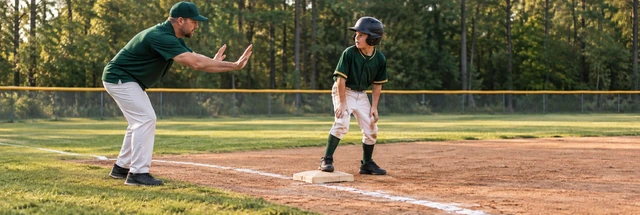
A base coach starts inside the coach's box and leaves only as the governing rule permits for a play at that base. A player serving as base coach wears a protective helmet. Give a voice or hand signal; do not push, hold or touch a runner to help them advance or return, because physical assistance can put the runner out.
Coach one decision at a time
A base coach watches the ball and fielders, then gives an early, clear stop or go call. A runner also watches the ball and must not wait until a throw is already arriving to decide.
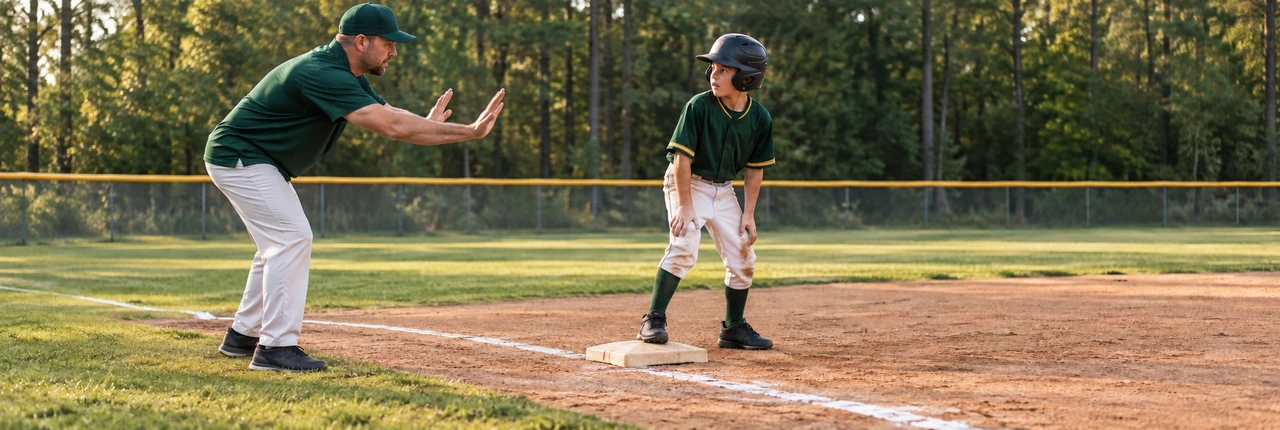
See example: A clear base-coach decisionExample hold decision. Use the agreed signal and watch the ball, outs and runner. This picture illustrates communication, not permission to leave a base before this division allows it.
Match contact to the situation
With a runner at third, talk through a ground ball, a caught fly and a ball through the infield. The number of outs changes whether the runner can advance safely.
Finish the live play
In Minor League AA and AAA, the batter is out on strike three whether caught or not. Keep watching the ball and other runners until the actual play ends; a batter-out call does not by itself stop every other live play.
Practice it here
Give the runner and hitter a sign before the pitch. After contact, the base coach reads the fielder and gives one early instruction that both can hear.
Situation 01
Make the sign clear
The batter and runner both look for the coach's signal before play resumes. A player who missed it uses the agreed reset request.
Around the bases: SLVLL AAA
Arrows show the running order, not when to leave a base · bases 60 ft apart · pitching distance 46 ft · schematic, not to scale. Rule source
1 Home to first
2 First to second
3 Second to third
4 Third to home
Coach answer: Asking for the sign again through the team's routine Ask for a sign again through the team's routine rather than guessing and sending teammates different messages.
Coaching Points
Rehearse the reset request as part of the signs, not as a failure.
Common Mistakes
A missed sign can create a safety and coordination problem.
Alternative Considerations
Keep early-season sign sets small; add complexity only when understood.
Coaching tip
Situation 02
Wait for legal departure
The pitcher is on the plate with the ball and the catcher is ready in the box. You coach a Minor runner at first.
Coach answer: Stay on base until the pitch reaches the batter AAA runners stay on base until the delivered pitch reaches the batter. Use the same cue in signs and drills.
Coaching Points
Rehearse the actual timing with a slow demonstration.
Common Mistakes
A delivery beginning is not the same as the pitch reaching the batter.
Alternative Considerations
AAA runners still choose a safe advance or return after legal departure.
A third-base coach sees the ball, relay and runner approaching. The coach uses the team's agreed stop or send signal clearly and early.
Coach answer: A visible, timely decision the runner can follow An early, visible stop or go call gives the runner time to act before a throw reaches the base.
Coaching Points
Practice communication with a jogging runner before adding a live relay.
Common Mistakes
Conflicting voice and hand signals make the decision harder.
Alternative Considerations
Aggressiveness depends on score, outs and player readiness; it is not a universal send rule.
Coaching tip
Situation 04
Name the contact-play plan
Before a situational rep, the coach tells the runner whether to read the ball first or act on a specific contact cue. Everyone repeats the instruction.
Coach answer: Name the cue, the safe fallback and who communicates it A contact play needs one cue, a safe fallback and a person who gives the call. The runner can then react consistently.
Coaching Points
Walk the scenario and then ask what changes on a line drive or a missed sign.
Common Mistakes
A slogan is not a complete base-running decision.
Alternative Considerations
Do not run a high-risk team play until the simpler read is reliable.
Coaching tip
Situation 05
Finish the AAA strikeout
First is empty with one out when an AAA third strike is not caught. In Minor League, the batter is out on strike three whether the catcher holds it or not.
Coach answer: The batter is out, not awarded an attempt at first The national Minor League rule puts this batter out on strike three even when the catcher does not hold it.
Coaching Points
The national Minor League third-strike rule differs from Majors.
Common Mistakes
Do not apply another division's familiar result without checking this one.
Alternative Considerations
Keep the catcher attentive to any continuing runner play rather than teaching every strikeout as a dead ball.
In an SLVLL AAA game, a committed bunt is allowed, but a fake bunt followed by a full swing is an out without a warning.
Coach answer: Choose a committed bunt or a normal swing, without fake bunt then full swing Follow the coached station instruction. Before a game, ask which written batting rule applies to this division.
Coaching Points
Explain the local instruction before the rep, then give one movement cue.
Common Mistakes
Do not invent a national rule number for a local restriction.
Alternative Considerations
Ask which rules apply before an interleague or tournament game.