Read these ideas, then try the situations below. Practice with a coach when a movement is new.
Quiz Mode: try each answer before checking the explanation.
Coach View: use the answers and teaching notes to guide practice.
Prepare every pitch
Before the pitch, check runners, outs and the next possible play. Give the pitcher a clear target while staying ready to move; after a miss, reset and communicate calmly.
Block a ball in the dirt
Move your body behind the ball, lower your center of gravity and try to keep the ball close. Find it before reaching for it; a rushed throw while the ball is loose can turn one base into more.
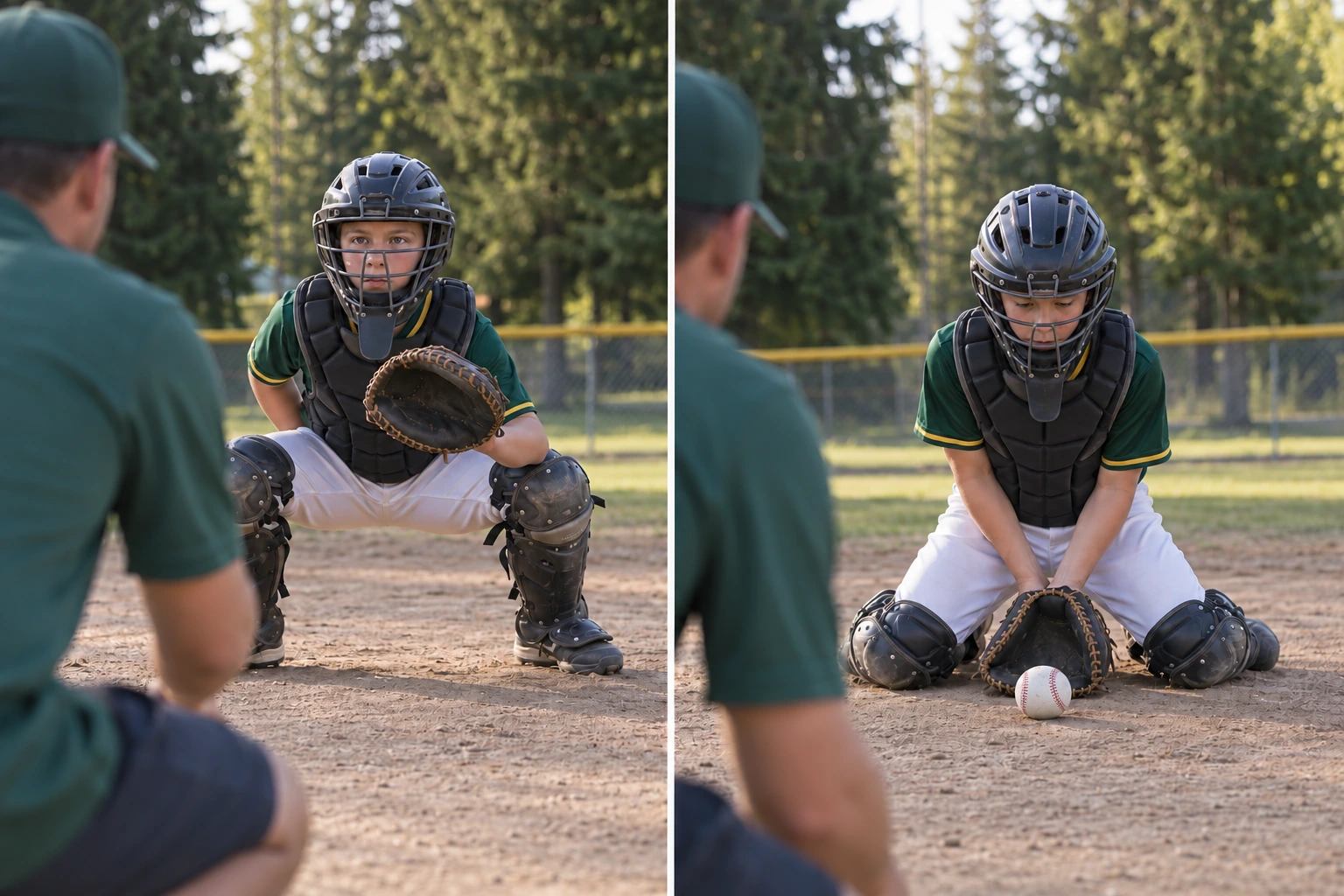
See example: Receiving and blocking setupPractice setup: receiving target on the left; glove low and body behind a soft practice ball on the right. The second frame is a blocking position, not a completed block or ball trajectory. Use full gear, short supervised sets and age-appropriate movement.
Receive and transfer
Receive the pitch under control. If a runner moves, locate the ball, set your feet toward a clear throwing lane, and make a throw only when the target and timing make sense.
Protect the plate
On a throw home, show the fielder a clear target while leaving a safe path for the runner unless you possess the ball and the rules permit the position. Catch the ball before applying a controlled tag. A late throw may be safer to hold than to chase across the runner's path.
Uncaught third strike
An uncaught third strike can leave the batter able to run when first base is unoccupied, or with two outs even if first is occupied. Know the outs and first-base situation before assuming the batter is out.
Change roles safely
The adult scorekeeper tracks both catching innings and pitching history. Tell the adult about pain or fatigue; never use a completed checklist as medical clearance.
Practice it here
In full catcher gear, practice a block, recovery and transfer on coach-fed soft pitches. Add a leading runner only after the adult, catcher and receiver agree on a controlled play.
Situation 01
Lead the pre-pitch conversation
Before getting into position, the catcher checks outs, runners and the pitch plan. An infielder confirms coverage for a possible steal.
Where everyone plays: PONY Bronco 12U
Bases 70 ft apart · pitching distance 50 ft · schematic, not to scale. The double ring marks 2, the catcher. Rule source
1 Pitcher
2 Catcher
3 First base
4 Second base
5 Third base
6 Shortstop
7 Left field
8 Center field
9 Right field
Coach answer: Confirm the pitch plan, runners and covered throw target Check the count, runners, pitch plan and covered throw target before the pitch. A late or unseen sign leaves teammates guessing.
Coaching Points
Keep signs simple and confirm that the pitcher can see them.
Common Mistakes
Changing a sign without telling the team creates preventable confusion.
Alternative Considerations
Agree a reset signal for any uncertainty; do not guess at a pitch.
Coaching tip
Situation 02
Keep a blocked ball nearby
At a controlled receiving station, the coach introduces a low ball after checking protective gear and spacing. The catcher works on keeping the ball in front rather than stabbing at it.
Coach answer: Wait for controlled blocking and a safe recovery Keep the blocked ball close and recover under control before adding speed, a throw or a runner.
Coaching Points
Introduce movement only after comfortable stationary repetitions.
Common Mistakes
A drill is not improved by overwhelming a player with speed.
Alternative Considerations
Return to a softer ball or dry footwork if control breaks down.
Coaching tip
Situation 03
Finish the third strike play
There are two outs and first base is occupied. The catcher does not catch strike three.
Coach answer: Yes; with two outs, occupied first does not prevent the attempt The outs and whether first base is occupied determine whether an uncaught third strike lets the batter try for first.
Coaching Points
Recover the ball, identify the available play and communicate. Permission to try is not an award.
Common Mistakes
The occupancy exception changes with the number of outs.
Alternative Considerations
With first occupied and fewer than two outs, the batter is out on the uncaught third strike.
A runner breaks for second. The catcher receives the ball, finds the target and makes a controlled transfer before throwing.
Coach answer: A repeatable receive-transfer-target sequence Receive, find a clear target, set your feet and throw under control. A hurried throw can give away another base.
Coaching Points
Reward a clean sequence and sound choice, not just a stopwatch result.
Common Mistakes
A rushed throw with no target can create an extra base.
Alternative Considerations
First-and-third situations need a separate team call agreed before the pitch.
Coaching tip
Situation 05
Report a throwing-role change
You caught today and the coach asks whether you can pitch. The PONY rule and your total throwing workload both matter.
Coach answer: Tell the coach about catching and wait for the PONY rule and workload check Tell the coach about every inning caught before a pitching assignment. Four catching innings in one game bars pitching later that day under Little League rules; PONY uses its own rule.
Coaching Points
The adult checks PONY eligibility and total workload before assigning a role.
Common Mistakes
A position change does not reset fatigue.
Alternative Considerations
A local league may have a stricter rule; report pain and let the adult decide.
The catcher's throws become less accurate and the player reports fatigue during a practice.
Coach answer: Stop the throwing work and reassess the plan A role change does not erase the throws already made. The adult checks the full record and the player's condition.
Coaching Points
Make it easy to report discomfort. Pain requires stopping pitching and appropriate medical evaluation.
Common Mistakes
Changing defensive labels does not remove the work already done.
Alternative Considerations
Use a non-throwing learning role while the adult adjusts activity.