Six topics that help young throwing arms: manage total workload and choose pitches that fit the player's league age. Tap the pitcher to explore the kinetic chain.
6Topics
12Quiz questions
4Chain links
1-4The Kinetic Chain
Tap any highlighted region to see its role, its conditioning drill, and how to keep stress off the throwing arm.

Quiz mode: tap an answer to check it, then see the coach's why.
Saving follows the selected profile. Signed-in notes, answers and team labels save privately to that profile. Signed-out training stays on this device. The account controls confirm server saves. Device records are imported only through an explicit personal-profile import. Do not enter a player's full name, medical information, contact
details, or any other sensitive personal information in any note, backup, or profile field.
Finish line
You reached the end of Lesson 8 of 8: Arm Strengthening & Injury Prevention
This is the last of the 8 player lessons. Return to the Pony Dugout to review any lesson.
Connect learning and practice
Practice this skill
Discuss workload, rest, eligibility and stop conditions with a responsible adult. A checklist or quiz result never clears a player to throw. Choose any physical rehearsal deliberately from the complete planner instructions.
Read the complete setup, equipment and stop instructions before activity. A missed question never prescribes extra throwing.
Compare the start and movement in the existing coach-guided routine. The illustrations show adult demonstrators; your coach selects the routine that fits you.
Compare the modest movement toward each other. This is an awareness image, not a diagnosis or a target range.
For the internal-rotation movement named above, ask the coach to demonstrate the exact setup. This picture does not guess a posture from “backward-facing.”
Generated illustration · example for coach-guided learning.
Stop if there is pain or form breaks down. Use the existing adult-supervised plan; these images add no sets, repetitions, resistance, treatment or return-to-play clearance.
Learning diagram
A progression, not a distance contest
Start close and easyWarm up within the coach’s plan.
Progress only while comfortableCheck accuracy and movement before another stage.
Return and check inUse controlled effort; include this throwing in the broader workload.
Pain → stop and tell the adult. Fatigue or fading control → stop the progression and reassess.
There is no universal distance shown here. Follow the coach-selected plan; the diagram adds no throwing dose or official game-pitch arithmetic.
Movement example
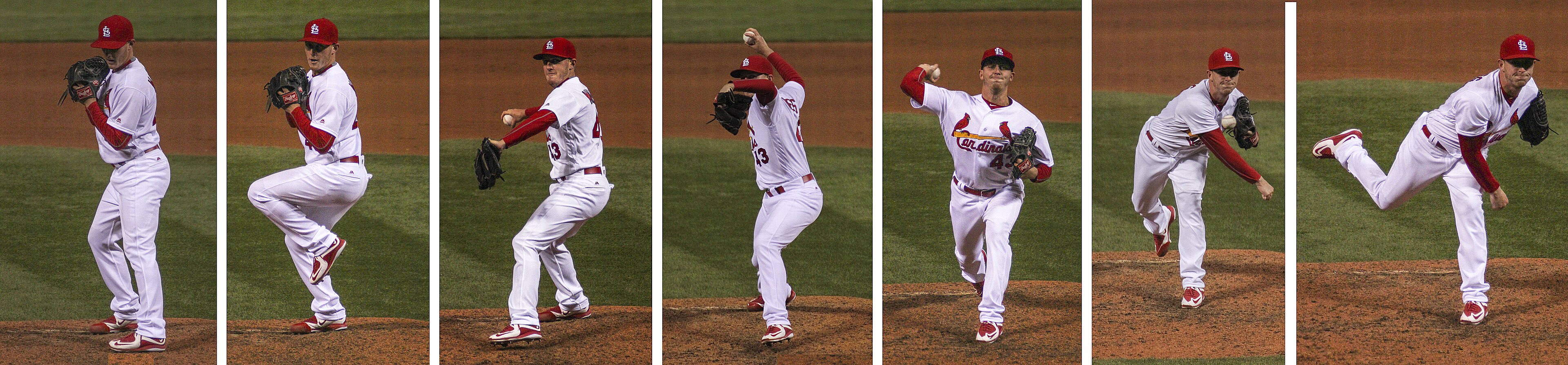
Connect the whole throwing body
1 · Lower body →Legs and hips begin the movement.
2 · Core / trunk →The body turns and carries movement upward.
3 · Shoulder / arm →The shoulder and arm follow the body sequence.
4 · Elbow / handThe arm delivers the throw and continues into the finish.
Photos displayed without content retouch; cropped details and mirrored studies are identified. These photo adaptations retain their stated licences. Photographers and players do not endorse this lesson.
The body links work together in continuous motion. This cropped adult photo helps identify the body regions; the linked labels explain their roles. It does not set joint angles, prove safe form or prescribe a training load.
Learning diagram
Speak up and stop when needed
Elbow or shoulder pain
Stop throwing
Tell the adult
Get the appropriate medical evaluation before pitching again
Fatigue or changing control
Report the change
Rest from throwing
Let the adult reassess the plan
A pitch-count ceiling or a completed checklist does not prove readiness. Pain and fatigue follow different responses; do not pitch through pain.
Learning diagram
Count full calendar rest days
Example · PONY · league age 13 · 40 pitches on Monday
Monday●Pitching day
Tuesday—Full rest day 1
Wednesday—Full rest day 2
Thursday?Next possible day
The final batter begins and ends within the 36–50-pitch rest band; no threshold exception applies in this example.
Tuesday and Wednesday are complete calendar pitching-rest days. Thursday is only the next possible pitching day after the adult checks all other eligibility, catching history and readiness conditions.
Learning diagram
Bring the whole throwing day together
Official game pitches
School / league games
Other team games
↓ Official pitching record
Other throwing and roles
Practice / warm-up / fielding
Catching history
↓ Broader workload check
One adult check-inReview the actual records, rest, roles and how the player feels.
A different team does not reset the throwing day. Other throws inform planning; they are not added to the official game-pitch total. Report catching separately.