Read these ideas, then try the situations below. Practice with a coach when a movement is new.
Quiz Mode: try each answer before checking the explanation.
Coach View: use the answers and teaching notes to guide practice.
Prepare every pitch
Before the pitch, check runners, outs and the next possible play. Give the pitcher a clear target while staying ready to move; after a miss, reset and communicate calmly.
Block a ball in the dirt
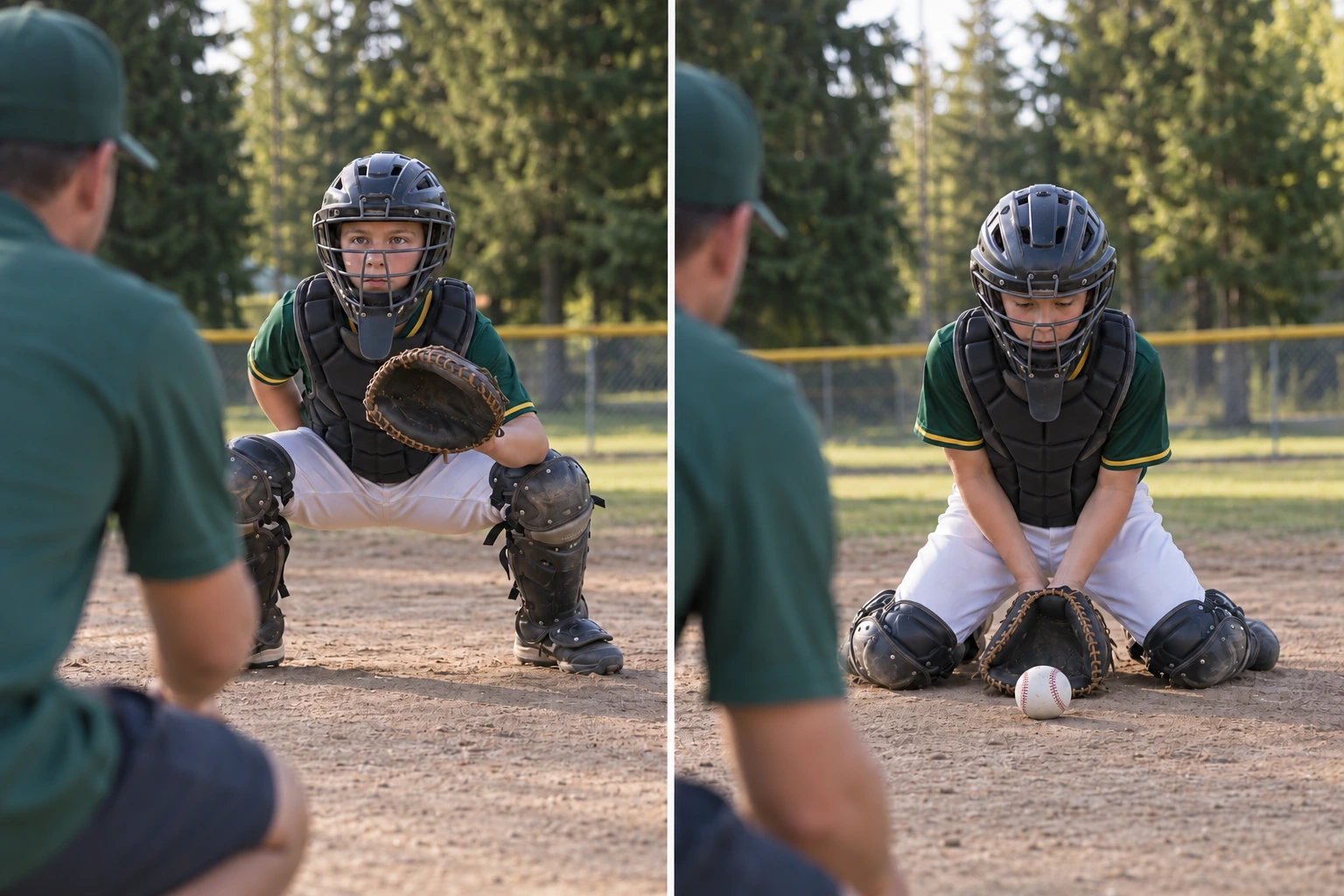
Move your body behind the ball, lower your center of gravity and try to keep the ball close. Find it before reaching for it; a rushed throw while the ball is loose can turn one base into more.
See example: Receiving and blocking setupPractice setup: receiving target on the left; glove low and body behind a soft practice ball on the right. The second frame is a blocking position, not a completed block or ball trajectory. Use full gear, short supervised sets and age-appropriate movement.
Receive and transfer
Receive the pitch under control. If a runner moves, locate the ball, set your feet toward a clear throwing lane, and make a throw only when the target and timing make sense.
Protect the plate
On a throw home, show the fielder a clear target while leaving a safe path for the runner unless you possess the ball and the rules permit the position. Catch the ball before applying a controlled tag. A late throw may be safer to hold than to chase across the runner's path.
Uncaught third strike
An uncaught third strike can leave the batter able to run when first base is unoccupied, or with two outs even if first is occupied. Know the outs and first-base situation before assuming the batter is out.
Change roles safely
The adult scorekeeper tracks both catching innings and pitching history. Tell the adult about pain or fatigue; never use a completed checklist as medical clearance.
Practice it here
In full catcher gear, first receive and block coach-fed balls without a runner. Add a runner taking a legal lead only when the adult has a controlled feed, a covered target and a clear throw lane.
Situation 01
Lead the pre-pitch conversation
Before getting into position, the catcher checks outs, runners and the pitch plan. An infielder confirms coverage for a possible steal.
Where everyone plays: Intermediate 50/70
Bases 70 ft apart · pitching distance 50 ft · schematic, not to scale. The double ring marks 2, the catcher. Rule source
1 Pitcher
2 Catcher
3 First base
4 Second base
5 Third base
6 Shortstop
7 Left field
8 Center field
9 Right field
Coach answer: Confirm the pitch plan, runners and covered throw target Check the count, runners, pitch plan and covered throw target before the pitch. A late or unseen sign leaves teammates guessing.
Coaching Points
Keep signs simple and confirm that the pitcher can see them.
Common Mistakes
Changing a sign without telling the team creates preventable confusion.
Alternative Considerations
Agree a reset signal for any uncertainty; do not guess at a pitch.
Coaching tip
Situation 02
Keep a blocked ball nearby
At a controlled receiving station, the coach introduces a low ball after checking protective gear and spacing. The catcher works on keeping the ball in front rather than stabbing at it.
Coach answer: Wait for controlled blocking and a safe recovery Keep the blocked ball close and recover under control before adding speed, a throw or a runner.
Coaching Points
Introduce movement only after comfortable stationary repetitions.
Common Mistakes
A drill is not improved by overwhelming a player with speed.
Alternative Considerations
Return to a softer ball or dry footwork if control breaks down.
Coaching tip
Situation 03
Finish an uncaught third strike
There are two outs and first base is occupied. Strike three gets away from the catcher.
Coach answer: Yes; with two outs first-base occupancy does not prevent it With two outs, a batter may try for first on an uncaught third strike even when first is occupied.
Coaching Points
Secure the ball and communicate the available play; do not assume the inning ended.
Common Mistakes
Remembering occupancy but forgetting the outs gives the wrong decision.
Alternative Considerations
With fewer than two outs and first occupied, the batter's eligibility is different.
A runner breaks for second. The catcher receives the ball, finds the target and makes a controlled transfer before throwing.
Coach answer: A repeatable receive-transfer-target sequence Receive, find a clear target, set your feet and throw under control. A hurried throw can give away another base.
Coaching Points
Reward a clean sequence and sound choice, not just a stopwatch result.
Common Mistakes
A rushed throw with no target can create an extra base.
Alternative Considerations
First-and-third situations need a separate team call agreed before the pitch.
Coaching tip
Situation 05
Speak up before changing roles
You caught a live pitch in four innings of the same game. Your coach asks whether you can pitch now. The adult game record says a player who catches four innings in one game cannot pitch that day.
Coach answer: I caught in four innings; please use me somewhere other than pitcher today Tell the coach about every inning caught before a pitching assignment. Four catching innings in one game bars pitching later that day under Little League rules; PONY uses its own rule.
Coaching Points
Track catching innings and pitch counts on the adult game record.
Common Mistakes
Even one live pitch caught in an inning counts as an inning caught.
Alternative Considerations
A legal role change can still be too much throwing; consider comfort and workload.
You caught earlier, then pitched, and now want to catch again. The coach keeps the official pitching and catching record.
Coach answer: Tell the coach every role and wait for the official eligibility check Tell the coach every catching and pitching role, then wait for the adult to check the official record before changing again.
Coaching Points
Regulation VI has a 20-pitch threshold for the return-to-catcher sequence and a separate 40-pitch rule.
Common Mistakes
Confusing these thresholds can make an ineligible catcher appear eligible.
Alternative Considerations
Keep the numbers in the official record, not in personal notes on this training page.