Read these ideas, then try the situations below. Practice with a coach when a movement is new.
Quiz Mode: try each answer before checking the explanation.
Coach View: use the answers and teaching notes to guide practice.
Know when you may leave
Before every pitch, know this division's lead and steal rule. A rule for another division can change the entire play.
Read the ball first
On a ground ball, look at its direction and the coach's signal. On a fly, see whether it is caught. If it is caught, retouch your original base before advancing. If it drops, read the live ball and the coach before moving.
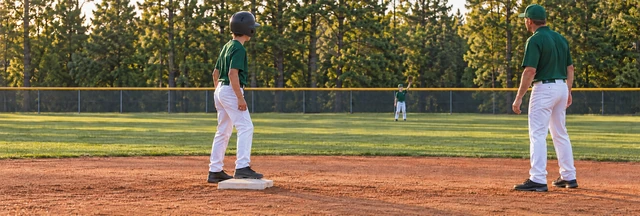
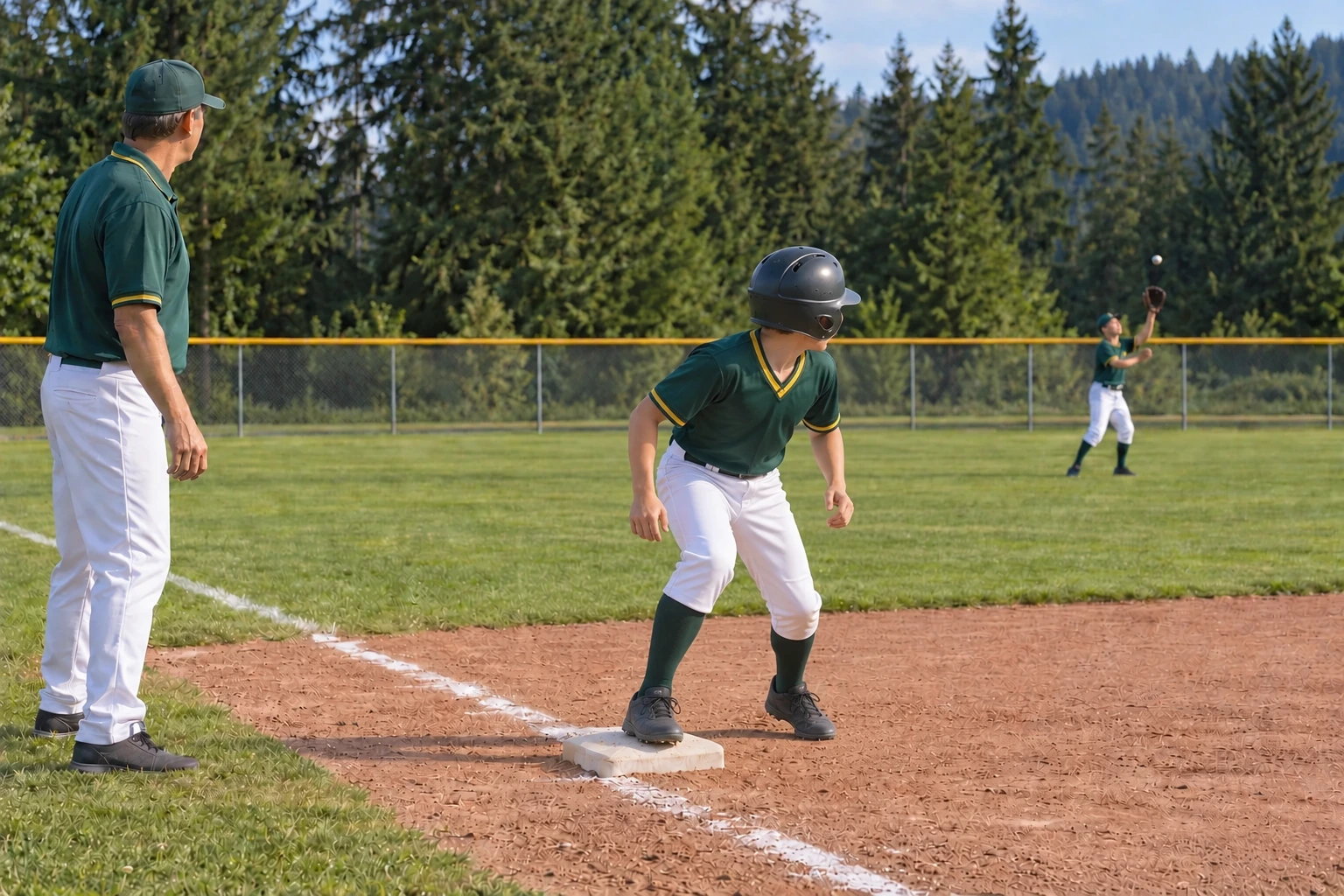
See example: Running through firstRun-through example: touch first and continue beyond it before slowing. This picture does not show rounding, returning or retouching. Follow the lesson for those different decisions.See example: Waiting on a fly-ball readBefore first touch: the runner remains in contact with the base while watching the approaching fly ball. The picture does not show a catch, departure or scoring decision. Read the lesson for retouch and permitted advance timing.
Move with control
Take a secondary move only when it is legal and manageable. Round a base while looking at the next play, then return promptly when the defense has the ball.
Practice a rundown
When caught between bases, keep your eyes on the ball, choose a base and run decisively. Do not turn away from a throw you cannot see.
Practice it here
Take a lead you can return from and watch the pitcher for a legal throw. On contact, read the ball before rounding the next base.
Situation 01
Identify this division's departure rule
A Bronco runner prepares on first while the ball is live. The national profile permits a pre-pitch lead.
Around the bases: PONY Bronco 12U
Arrows show the running order, not when to leave a base · bases 70 ft apart · pitching distance 50 ft · schematic, not to scale. Rule source
1 Home to first
2 First to second
3 Second to third
4 Third to home
Coach answer: Bronco permits leads and legal pitcher pickoff attempts Bronco permits a pre-pitch lead and legal pickoff attempts. Return under control when the pitcher throws over.
Coaching Points
Start with a controlled lead and rehearse the return; 70-foot bases do not make this a Little League profile.
Common Mistakes
Never turn a rule from another division into this runner's instruction.
Alternative Considerations
The coach can reduce a training lead for readiness without presenting that choice as a national requirement.
Bronco permits pre-pitch leads and legal pitcher pickoff throws.
Coach answer: A practiced read that distinguishes delivery from a legal throw over Watch the ball and the legal timing before committing. Guessing at a pitcher's first motion can send you into a tag.
Coaching Points
Demonstrate slowly and ask the runner what was observed before adding speed.
Common Mistakes
Guessing on every motion is not the same as reading a pitcher.
Alternative Considerations
Bronco runners may lead, but should still read a legal throw and return under control.
In Bronco, after a controlled lead, you read the delivery, the ball and the catcher while staying balanced for the next action.
Coach answer: Follow the legal timing and stay balanced to advance or return Bronco permits a lead, but you still read the delivery or legal throw and keep a controlled return.
Coaching Points
Practice both the advance and return from a balanced position.
Common Mistakes
Movement that looks quick can still be illegal or uncontrolled.
Alternative Considerations
Coach the actual rule and the runner's readiness together; neither replaces the other.
An infield fly is declared and then caught. You are a runner deciding whether to advance.
Coach answer: The catch still creates retouch responsibilities If a fly is caught, retouch your original base before advancing. The infield-fly call does not cancel a real catch.
Coaching Points
Read the catch separately from the batter-out call and listen to the base coach.
Common Mistakes
An infield-fly call is not permission to ignore the catch.
Alternative Considerations
Walk through a ball that drops untouched too; do not treat caught and dropped versions as identical.
On an extra-base chance, find the base coach early enough to act on the agreed signal. Touch the base under control and keep awareness of the ball.
Coach answer: A clear stop or continue signal and a controlled turn A controlled turn keeps the next base in view while giving you time to follow the coach's stop or continue call.
Coaching Points
Start at a jog, then add speed when the runner reads the signal reliably.
Common Mistakes
A fast turn without a read can send the runner into a bad decision.
Alternative Considerations
Field conditions and player confidence may require a slower progression.
Coaching tip
Situation 06
Return under control
In a supervised return drill, the pitcher makes a legal throw to first while you are a few steps off the base. You need to get back without colliding with another player.
Coach answer: A controlled return with safe spacing Return with your eyes on the ball and room to slide or stop safely. Do not drift farther while the defense controls it.
Coaching Points
Begin without a live tag; add a controlled throw only after the return is understood.
Common Mistakes
Permission to lead does not guarantee every lead or return is safe.
Alternative Considerations
Use a conservative return technique taught by the coach; do not turn a training preference into a borrowed national sliding rule.